We are so lucky to live in Missouri! When fourth graders learned the folk song and play party game called "Paw Paw Patch" most of the students didn't know what they were. Thanks to a wonderful parent for sending in a couple of real pawpaws for students to examine.
Header
Jazzy Jack-o-Lanters
Students in first grade were given a sheet of music symbols. We identified the ones we new and briefly talked about the new symbols. Then I challenged students to use only music symbols to create a jazzy jack-o-lantern. I showed them some samples from a bulletin board I created and they were off. I love how creative they were!
Carnival of Animals
One of my favorite Second Grade units is Carnival of the Animals. We learn about this music of Saint Saens and do some fun activities that focus on listening skills. Carnival of the Animals is a set of pieces that Saint Saens, a French composer, wrote as a joke. These pieces were all meant to sound like, imitate or make you think of various animals. To begin this unit we listened to a few pieces and imagined what the composer might have wanted us to identify. "Do the strings sound like chickens in this piece?" "Why do you think Saint Saens used a low sounding instrument for the elephant?" and "What instrument is playing the roar of the lion?" were just a few questions we discussed while listening.
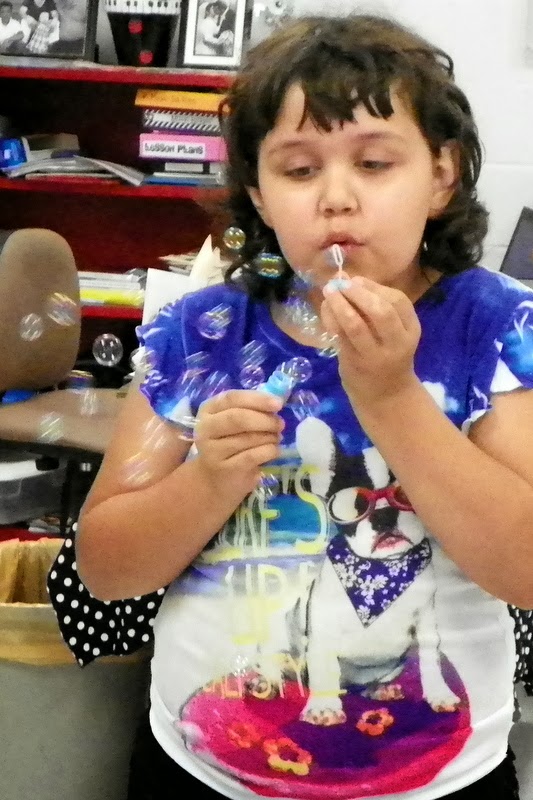
Later while listening to "The Aquarium" we discovered a new note-the whole note. This note looks a lot like a donut and gets four counts (ta-a-a-a). We moved to the whole note and then used bottles of bubbles to blow through the whole note. Students used their critical listening skills and stirred bubbles until they heard a whoe note in the melody and then blew four counts worth of bubbles.
A few weeks ago I attended a workshop by Dan Fee (who is AMAZING!). The bubbles and the cup stacking in the next activity were ideas that he described in his workshop. The kids had such a great time! For the "Tortoise" we moved very slow, like tortoises, and stacked cups. Only by moving slowly like a tortoise could we get our stacks all the way up. During this activity students got to hear this amazing music over and over, used problem solving skills to decide how to complete the task alone, with a partner and with a group. Fun!
Other Carnival of the Animals activities included using ribbon streamers to dance like birds and to identify the "cuckoo" sound made by the clarinet in the "Cuckoo" piece.
Watch the video we watched in class HERE. This video allows students to hear Carnival of the Animals poetry, see the animals from the pieces and hear an orchestra perform the music.
You might like this Carnival of Animals Bundle that includes Carnival of the Animal crafts, listening logs, coloring pages and a bright and beautiful bulletin board. I love, love, love this set!
Autumn Leaves are Falling
Students in Kindergarten and First Grades listened to the song "Autumn Leaves" which is in a minor key. We responded to the music by moving back and forth to the beat like trees waving in the wind. Next we added "leaves" to our dramatization by holding scarves and moving to the flowing, minor melody. I love how the kiddos were so passionate and expressive!
Star Spangled Banner Centers
GES third graders have just finished their Star Spangled Banner unit. During this time students learned about the composer, Francis Scott Key. They also learned about the history of the song, defined some hard words in the first verse and worked to memorize it. The pictures below are of the Star Spangled Banner Workstations we did.
Sticky Note Singing
This is what workstations look like in the music room. This group worked so well in groups. Look at all the learning taking place!
Sing In the Blanks Workstation
Listening Station
Teachers: You can get the workstations here.
Word Find
Definitions
Sticky Note Singing
Phrases
Write on!
Paint Chips and Pins=Rhythm fun!
Good beat keeping and rhythm skills come through repeated practice. Its fun to find new ways to practice reading and performing rhythms. In this activity students use clothes pins with notes on them and paint chips (don't you think they look like a four beat measure too?).
I explain that every rectangle on the paint chip is a beat. Some beats have one sound, others have two. What note makes one sound per beat? A quarter note (or ta). What notes do we use when we want two sounds on a beat? Barred eighth notes (titi). Later these students will use the pins for half notes and whole notes as well.
Can music training help you become better at language and reading?
Researchers are finding strong connections between good musicians and good readers. Read more at these links:
Got Rhythm? You can learn language and reading better.
Study Ties Beat Keep with Language and Reading Skills
Brainvolts at Northwestern University
Got Rhythm? You can learn language and reading better.
Study Ties Beat Keep with Language and Reading Skills
Brainvolts at Northwestern University
Subscribe to:
Posts (Atom)