Header

Mrs. King at Home About Mrs. King Contact Mrs. King Mrs. King's Music Class HOME Image Map
Showing posts with label 1st grade. Show all posts

99 Music Workstations You are Going to Love


A HUGE list of Music Workstations for the elementary music classroom.  You are going to love these center ideas for pitch, rhythm, singing, composing, playing instruments and more.

I love using workstations in my classroom.  I wanted to share a list of some of my favorites, but I think I got a little carried away.  Here are almost 100 workstations that I love with links and explanations.  Enjoy!

Coloring

Color by Note  These activities are fun for students an allow them to show what they know by coloring their answers.  Some of these activities may take more than 10 minutes.
Writing Prompts   Perfect for workstations!  Students write an answer, a paragraph or a story based on the prompts.  Use regular paper or Chrome books and Google Classroom!
Composer Coloring Sheets  Although I often use these while listening to music, they work great in a workstation.  Even the big kids enjoy this!
Primary Writing Prompts   Younger students that may be pre-readers, need to be able to express their ideas with words and pictures.  These primary writing prompts provide space for both.
My Book of Mary Poppins. As a review after we have watched the movie (or portions of it), we color these books that highlight some key items in the movie.
Instrument Coloring Sheet This is probably pretty obvious.  Coloring sheets for instruments or for groups of instruments in their families are great for workstations.
Music Memory Book This is best when used at the end of the school year.  I usually have students work on the books for about half of a class period.  Next class, they finish them as one of the stations that I have set up.
Roll and Cover worksheets  Easy peasy.  Print and set in a workstation with some crayons and some dice.  Actually I use one BIG die and the group shares.  Fun!


Composing

I find that it is really difficult to complete a composing project in the small amount of time that students have in a workstation.  So, instead of doing an entire project, these centers allow students to compose by arranging.  Take a closer look:


Dynamics and Tempo

Candy Corn -Dynamics  This seasonal workstation is simple to do.  Students complete a candy corn puzzle that contains a dynamic term, symbol and definition.  Then, they copy that information to a chart.
A Dab of Music Learning - Dynamics and Symbols  I love dabbers and so do my students!  The set focuses on dynamics and music symbols.  I usually plan 2-3 worksheets for one center.
Dynamics Punch Cards  I have quite a few hand held hole punchers and they come in handy for this station!  Take a closer look by clicking on the link.


Instrument Families

A Dab of Music Learning- Instruments   Another dabber activity set.  This set focuses on instrument families and provides many opportunities for students to show what they know.
Instrument Matching Game  Use pictures of instruments or print this set to use to have students match pictures of instruments with the names of instruments.
Mystery Instruments  One of my favorite activities. I tell students to be sneaky detectives and not tell any other groups what instrument they think is the mystery instrument.  They fill out a "case file" that records the clues they discover. At the one of the center rotations I open the bag and show the class.  Using a different instrument, you could do this many times.
Clip It-Instruments Edition   Just add clothespins to these cards for an engaging workstation that reinforces instrument names and simple rhythm patterns.
Read It, Trace It, Stamp It  This station requires some letter stamps and an ink pad.  Get the washable kind of ink pads.  Trust me.
Dip Tray Family Sort  Using an inexpensive dip tray from the dollar store, this station is a breeze to set up.  Read more about it.
Instrument Coloring Sheets  Use these to reinforce your unit on instrument families.
Instrument Family Punch Cards  Which of these instruments is in the brass family?  Punch your answers with a hole puncher.  Fun assessment.
My Book of Instruments  These take a little bit of time to copy and assemble but are great for small group work or workstations.  Do one family at a time or all instruments at the same time.
Instrument Investigations  This activity takes 15- 20 minutes so you may need to plan a day of longer workstations to make this go well.
Misspelled Instrument Punch Cards  I think it is important that students learn to spell instrument names correctly.  I don't always feel like I have enough time during instruction, so I love adding these punch cards to a workstation rotation.


Movement

Yes!  You can do a movement center!  Set clear expectations and add music (or not) and these activities work so great in stations.  Student love them too.


Non-Pitch Percussion Instruments

Playing instruments is one of my students' favorite workstations and I understand why!  These station sets make playing instruments a pleasant and organized experience.  No, really.d


Pitch

A Dab of Music Learning - Intervals  These dabber activities are great for upper grades.
A Dab of Music Learning -Pitches   Drilling pitch names doesn't have to be boring.  These dabber activities are designed to be completed quickly.  That makes them perfect for workstations.  
Treble Clef Twister  There are many ways to do this, but essentially it requires a staff on the floor.  This could be one that you create with tape, one you already have on a rug or one that you draw on a plain shower curtain.  The link will take you to a sheet that I use as a spinner.
Musical Mneumonics  Another way to drill those pitch names is to have students create their own musical mnemonics.  
Bottle Cap Staff   I have collected hundreds of bottle caps from 2-liters of soda, water bottles, etc...  They make perfect note heads.  Take a closer look to see how it could work in a center.
Bottle Cap Pitch Sort  I also took some of those bottle caps and modge-podged some staves and notes on them.  Students sort them into piles based on their letter name.
Flashcards  - Yeah.  They are boring, but neccessary.  It seems that kids hardly ever use them anymore so maybe they will find them to be a novelty.
Worksheets   I know.  It sounds boring, but these worksheets are attractive and easily completed in the time that students have in a workstation.
Swat the Staff  Create a staff on the wall with tape.  Two students stand next to it, another calls out a letter from the musical alphabet.  The first one to swat the correct line or space wins!
Pitch Match Ups  Basically flashcards, but you match words spelled out by notes on the staff to the words.  Lots of fun designs.
Bop It/Simon Says  Melodic retention.  :-)


Reading

I almost always use my reading area as a stop in the workstation rotation.  Here are some links that might help you out with your reading area.
Classroom Library  Need some ideas for your reading area?  Check out this huge list!
Books for Primary Classes  This is a great list of books that your primary classes will love.
Men and Women of Jazz  Print and laminate the pieces of this bulletin board and include them at a workstation.  They contain short passages and students have time to read more than one during their center rotation.
Meet the Composers  Similar to the Men and Women of Jazz, this bulletin board set can become a reading station too.
Magazines - Do you subscribe to Music Alive or Music Express?  Leave a few copies in a crate and set it in the floor.  Instant workstation!


Rhythm

A Dab of Music Learning - Rhythm  Dab.  Dab. Dab dab dab.  Note values, musical math and more in this set.
Drawing Notes-lap packs  This link takes you to a blog post about Lap Packs.  I've used them with Kindergarten through high school.  For the littles, it is a great way to practice drawing notes.
Swat the Rhythm  We like swatting things in my classroom.  The link takes you to a few sets that I have created.  You can do the same activity with flashcards.  Lay them on the floor.  One student claps a rhythm that is on one of the cards.  The first student to swat the right answer, wins a point.  
Rhythm Blocks  Duplos and legos make great music workstations!  Check out this blog post to learn more.
Craft Stick Rhythms - Take craft sticks and use them to make quarter notes and barred eighth notes.  Students clap their "compositions" and then make more.
Roll and Cover  Roll and cover activities allow students to reinforce their knowledge of note names.
Musical Yahtzee  From Layton Music, this activity is great for small groups or workstations.  I laminate the score sheets when using them in workstations and add some music dice.  
Noodle Notes. I love pool noodles!  Learn about how to create noodle notes in this blog post.
Caterpillar Rhythms   Construction paper circles or paper plates become caterpillar bodies in this activity.  Add rhythm patterns or single notes on them and students build a caterpillar pattern.  The longer, the better!
Play Dough Mats  Laminate and just add play dough.  Students learn about notes and symbols through play.
Don't Break the Ice -take a Don't Break the Ice game and draw different notes on each block (quarter, half, barred eighths, 4 16ths, etc....).  Create a spinner with whatever note values you used.  Students spin and the tap out one block with that note on it until somebody breaks the ice.
Add it Up Rhythm Cards  Musical math!  This freebie can be used in many ways.
Note Value Punch Cards  This is another activity for hole punchers that can assess student knowledge.
Rap It Clap It Music Match It  This is an old faithful workstation for me.  Students match the syllables of themed words to simple rhythm patterns.  Perfect for a workstation.  I often do this activity with the whole group and use it in a workstation later.
Clip It Games  Clip it games require students to match words with a rhythm pattern that most closely matches its
Rhythm Pins w/Paint Chips  Cut the paint chips so that there are 4 boxes on them.  Draw single beat notes or rhythms on clothespins.  Students pin a measure on the paint chips, clap and repeat.
Candy Land (note differentiating)  Instead of using Candy Land for just color recognition, add music symbols, notes, pitches, etc... to the colors.  Fun!
Musical Jenga - Check out this awesome idea from the Music K-8 Idea Bank for creating a musical Jenga game.
Tracing Sheets  Get acquainted with notes and their values with these tracing sheets.  Great for younger learners.
Music Math Houses   I laminate these and use dry erase markers.  Students add up all of the musical math problems in colorful houses and check their own answers.
Note Knacks. These are great!  I have one student create a four beat measure and the others recreate it with the Note Knacks.  They are a little pricey, but worth it.
Dot Composing  This is a simplified way to compose using quarter notes, barred eighths or 4 16th notes.  Read more about it in this blog post.
Rhythm Blocks  Kelly Parrish from Rhythmically Yours makes these amazing rhythm blocks.  I use them for rhythmic dictation.  At a workstation, one student secretly creates a rhythm pattern and then claps it for their group.  The other students recreate that with their rhythm blocks.
Poison Rhythms. Using a lap top or table, I have students play poison rhythm just they way we do as a whole group.  FUN!  The link will take you to several different versions.


Vocal Stations

Vocal Explorations  -Vocalizations are a few workstation and let students be a little silly and creative.
Puppets and Books  Use puppets and some Wee Sing books at a station.  The goal?  SING!
Sticky Note Singing   Take a song that you are working to have memorized.  Cover part of it with a sticky note and try singing it.  Add another and try again.  Let your neighbor add the next one and try again.  It is a fun way to work on memorization and to get students singing at their center.
ABC Chart   This one is easy peasy to create.  Check out the blog post for a simple description of this activity.
Singing Sticks from Music Mom  These little singing sticks are great tools to reinforce Solfege or at my school to reinforce the pitch numbers of a major scale.  After using them with classes for a while, they can easily practice in workstation groups to sing patterns.
Singing Rocks   I love my singing rocks!  They really allow for improvisation and creativity.  After I have modeled this activity in class, students are able to do it in a workstation.  It is great to listen to them sing their imaginations out!
Blob Chorus - Ear Training  This is an app that is so fun that students don't realize they are learning!  Hurray!

STEAM

Xyloba   Engineer a marble run that plays a song with this awesome set!
Found Sounds  Collect some junk.  Put it in a box.  Let students become detectives, inventors and musicians.
Stikbot Animation  Animate a dance.  Choreography and green screen technology can create some amazing videos.
Spec Drums  There are so many ways to use Spec Drums in workstations:  exploration, composition, practicing simple folk songs and more!
Ozobots   Code these little robots to show the tempo changes of a piece of music.  Use the workstation time to have them practice creating paths that change speeds (or tempos!).
Makey Makey   My students always fight to be the first group at this station.  I add the instructions, a Makey Makey invention set and some random things for students to experiment with like fruit, play dough, hot dogs...whatever.  Students use these items to play a keyboard or drum on the computer.  I definitely recommend this activity!


Apps

There are SO many great music apps out there.  Here are a few that I think work really well in workstations.


Miscellaneous

Music Interest Inventory Punch Cards   This is a fun addition to workstation rotations at the beginning of the school year.  You can learn a great deal about your students.
Talk About Tunes   I mean, they are going to talk anyway.  Why not make it musical?
Carnival of the Animals  -Use a day of workstations to review Carnival of the Animals.
Peter and the Wolf - This set lets you expand your Peter and the Wolf unit in some fun and creative ways.
Star Spangled Banner   I use this every singing year with 3rd or 4th grade.  It is a great way to learn more about our national anthem, help students memorize it, learn the vocabulary and more.  I always plan a couple of class periods to do all of the stations in this kit.


Whew!  What a list!  If you loved these ideas, PIN THIS for later!
A HUGE list of Music Workstations for the elementary music classroom.  You are going to love these center ideas for pitch, rhythm, singing, composing, playing instruments and more.


 post signature

Rhythm Cards for Rockin' Repetition


Use these simple rhythm cards to establish routine and improve rhythm and steady beat skills in your music classroom.  In music education the simplest ideas are the best. Your students will thank you for adding this activity to your music routine.


I love creating a routine at the beginning of my classes.  It helps students focus and gives me a second to handle questions and get things ready to go.  For some classes this is a hello song, echo clapping or a movement activity.  In this post I'll share one of my favorites.  Rhythm cards are the perfect way to get students thinking and moving in music class.

The rhythm cards that I am referring to have 4 beats worth of notation.  I copy the same card on front and back so that they are easier to use. One card has 4 quarter notes.  Another has two half notes and so on.

When using these cards I am reinforcing note values and sharpening skills that we will use in other activities to compose rhythmic ostinatos or melodies.  Students are able to feel the duration and this makes a strong connection.  Using this activity at the beginning of each or during each class for several weeks in a row has been a great skill builder!  I like to call it "rockin' repetition".

Use these simple rhythm cards to establish routine and improve rhythm and steady beat skills in your music classroom.  In music education the simplest ideas are the best. Your students will thank you for adding this activity to your music routine.


I wish this simple but brilliant idea was mine, but I actually learned about it from Kristin Lukow, music educator extraordinaire on the Music K-8 discussion list.  I've incorporated it into lessons for many years now and my students are better for it.  Thanks Kristin!

Here's what I do:
I choose a song with a medium to fast beat (which are much easier than slower songs) and start it as students are walking into music class.  They clap the pattern as an ostinato until I change the card.  That's really it!

Use these simple rhythm cards to establish routine and improve rhythm and steady beat skills in your music classroom.  In music education the simplest ideas are the best. Your students will thank you for adding this activity to your music routine.


This activity works great with my drums, classroom percussion instruments and different kinds of body percussion instead of just clapping.  Often we will do this with tennis balls or basketballs (if I can borrow some).  When we use balls with the cards here are the movements:

whole notes - count as you move it around your waist, back and then to your front.  Think of it as traveling around the world.
half notes - bounce so that the first part of the note is when the ball hits the floor and the second is when you catch it
quarter notes -same as half note but on each beat.  It helps to be closer to the floor for this one.
eighth notes-hot potato!  We pass it from hand to hand in rhythm.

Since this activity is used many times during the school year my play list is pretty diverse and always growing.  I include songs that I'll use with tennis balls, basketballs and with body percussion.  I can choose faster pieces for body percussion than the others.  Some student favorites:

"Can't Stop This Feeling" by Justin Timberlake
"Song of the South" by Alabama
"The Star and Stripes Forever" Sousa
"Best Years of Our Lives" by the Baha Men
"I Love a Rainy Night" by Eddie Rabbit

You can check out my entire playlist for rhythm cards here:  Rhythm Cards Playlist on Amazon Music.

I know this is a simple idea, but once you've implemented it I think that you'll find it  is helpful not only for establishing routine, but for improving rhythm skills and steady beat with your students.  I'm so sure it will that I want you to have a copy of the cards for free!  Print out two copies and laminate the same pattern back to back.  Get the cards here: Rhythm Cards for Rockin' Repetition


Use these simple rhythm cards to establish routine and improve rhythm and steady beat skills in your music classroom.  In music education the simplest ideas are the best. Your students will thank you for adding this activity to your music routine.


post signature

Take Music Class Outside

Outside activities for music class can be just as engaging as activities that you plan for inside the music room.  Sing, dance, play and assess in the sunshine.  Nine practical ideas for beautiful days in music class.

Take your music classes outside!  No, not just for an extra recess.  Take them outside for an extra special music class!  When the days are sunny and warm, you can go outside to sing, dance, play and even assess.  Here are 9 practical ideas for beautiful days.

Outside activities for music class can be just as engaging as activities that you plan for inside the music room.  Sing, dance, play and assess in the sunshine.  Nine practical ideas for beautiful days in music class.

1.  Musical Hopscotch
There are plenty of ways to play musical hopscotch.  With a little sidewalk chalk, create a hopscotch board.  What you put inside each square depends on what skills you want students to practice.

Note Values:  Draw note with values from smallest to largest on the blocks if you wanted to work on note values. Students would pause on each block as they counted the notes or said the syllables.  Add multiple notes to get all the way to ten or create a hopscotch board in a different shape to accommodate your needs.
Solfege:  I created a hopscotch board (pictured above) with the syllables of a major scale.  I added sol and do in the spaces of 9 and 10 on the board.  To warm up, we hopped and sang the syllables ascending and descending.  Then the game started.  Students would roll their rock and skip whatever syllable it landed on.  They hopped through the board singing each syllable except the ones that were covered.  This game was challenging and so much fun.  What I discovered was that when I wasn't actively engaged with a group, their singing skills weren't very strong.
Pitch:  I haven't tried this with students but I would love to try a version where some students jumped and other students played corresponding Boomwhakers.  That would be lots of fun too!

Outside activities for music class can be just as engaging as activities that you plan for inside the music room.  Sing, dance, play and assess in the sunshine.  Nine practical ideas for beautiful days in music class.

2.  Treble Clef Twister
When I play Treble Twist Up in class, I use a shower curtain that I have created a treble clef staff on and students take off their shoes and play the game like regular Twister.  Outside the shower curtain could work, but it wasn't a different enough experience in my mind.  If you have a playground that has the large foam squares as the "floor" of the playground you could create a treble clef staff with chalk on it to play.  Another idea is to spray paint the staff onto a grassy area.  The next time the grass is mowed, the staff is erased.  (You might want to get permission before you do this!)  Add THIS spinner and you have a great outside game that reinforces pitch names.

Outside activities for music class can be just as engaging as activities that you plan for inside the music room.  Sing, dance, play and assess in the sunshine.  Nine practical ideas for beautiful days in music class.

3.  Yard Dice - Roll and Cover
I needed an excuse to buy a set of LARGE wooden dice.  *giggle*  Outside music class seems like a great reason!  I must confess that I already have a collection of large foam dice that I use inside and they would work perfect outside as well.  So, what do I do with them?  I use them with Roll and Cover worksheets.  In a milk crate, I pack a few clipboards, pencils and a stack of Roll and Cover worksheets.  This makes the entire station easy to transport and gives me a place to collect finished pages. Check out the Roll and Cover sets here:  Music Roll and Cover

4.  Parachute Games
Parachute games are perfect for outside music class.  My current music room doesn't have a high enough ceiling for very many parachute games so taking the activity outside is the only way I can use them.

When planning parachute activities think about using songs your students already know that utilize direction words like up, down, around, etc...   I like to use "The Noble Duke of York" and "The Itsy Bitsy Spider".

Add a football to the middle of the parachute and change the lyrics to "My Bonnie Lies Over the Ocean" and you have a fun singing parachute game. Just change the word "Bonnie" to "football".  Add more actions to make it even more challenging.

"Charlie Over the Ocean" is a fun song to sing with a parachute.  Before each round choose a weather forecast like: warm and sunny, windy, stormy, hurricane, blizzard, calm and cool.  Students sing and move the parachute to match the weather forecast.  It is even more fun to toss a ball in the middle and focus on keeping it on the parachute during any weather condition.

.
Outside activities for music class can be just as engaging as activities that you plan for inside the music room.  Sing, dance, play and assess in the sunshine.  Nine practical ideas for beautiful days in music class.

5. Ukuleles
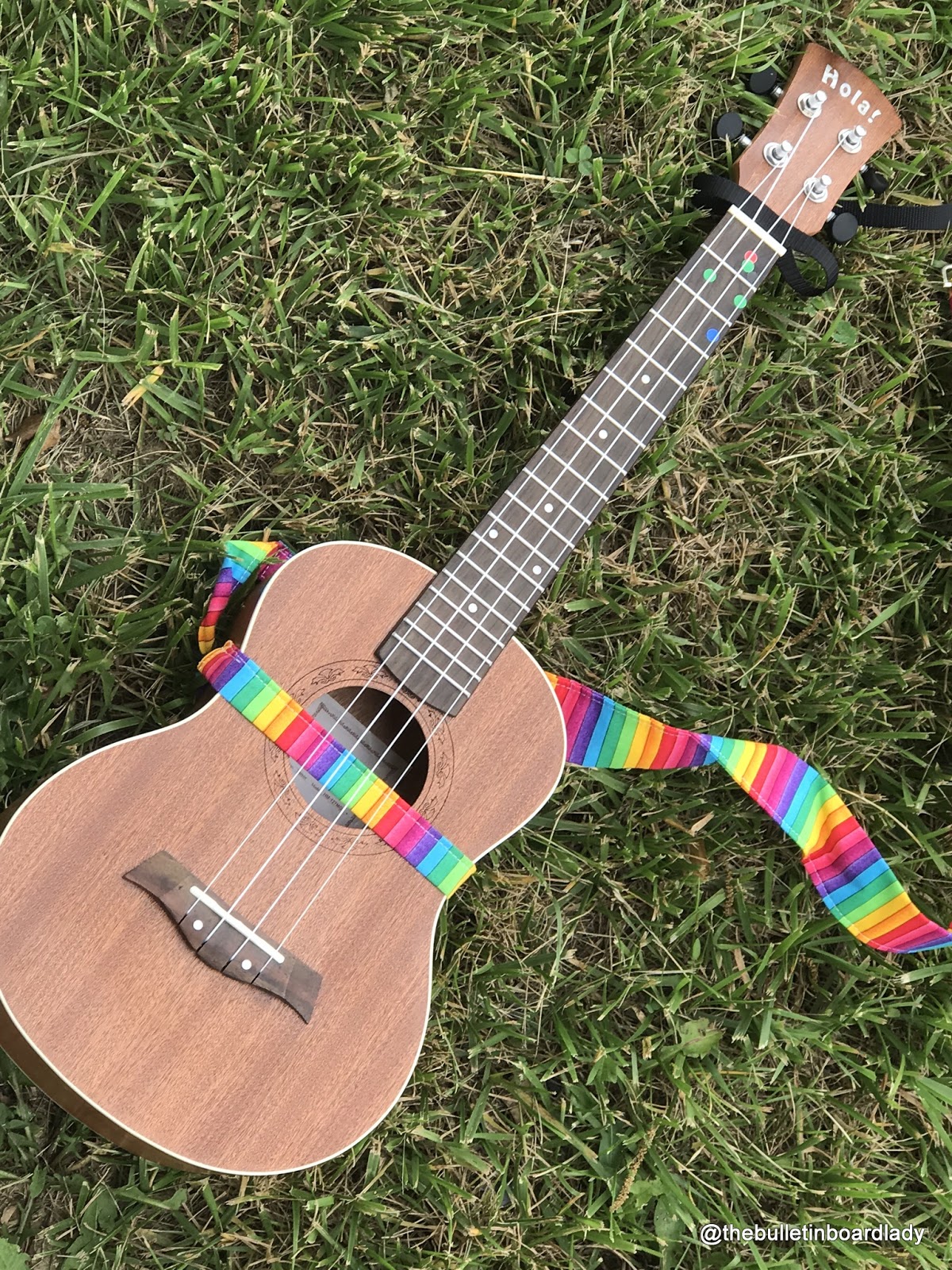
I am relatively new to teaching ukuleles, but they have proven to be a versatile instrument and are perfect for taking outside.  Take a few song books for students to work on in small groups or move your whole group instruction out to the lawn.


Outside activities for music class can be just as engaging as activities that you plan for inside the music room.  Sing, dance, play and assess in the sunshine.  Nine practical ideas for beautiful days in music class.

6.  Four Corners - Instrument Families
Four Corners is a game that has been around for a long time.  I use it to reinforce instrument families.  Draw the four corner boxes and in each one add the name of an instrument family.  One student calls out the name of an instrument and the players move to stand in the family box that it belongs in.  Anyone who is not in the correct box is out.

This game was great with second and third graders, but my 4th, 5th and 6th graders were too good!  To make it a little more complicated I created instrument cards for the caller to use.  I included many instruments from around the world, pictures of those instruments and then their name and family to make the game more interesting.  If the game gets to the point where no one gets out for 3 turns, then the caller turns around giving the players a chance to stand in ANY box and then chooses a family.  Anyone not in that family is out.  Play continues until there is one winner and that person becomes the new caller.


Outside activities for music class can be just as engaging as activities that you plan for inside the music room.  Sing, dance, play and assess in the sunshine.  Nine practical ideas for beautiful days in music class.

7.  Singing Rocks
Singing rocks are great inside or outside.  There's just something fun about taking them outside.  I explain how to make these rocks in this blog post:  Singing Rocks

Basically the rocks are used for singing improvisation.  Put the rocks in a bag or box that isn't easy to see into.  Pull out a rock and start singing about what is on the rock.  The song doesn't have to rhyme.  The next person pulls out another rock and continues the ballad by singing about what is on their rock.  This is a great way to introduce the idea of opera too.  I've used this activity as a workstation and as a whole group activity.

8.  Singing Games/Folk Dancing
Ah!  Finally enough room to do all of those dances as an entire class instead of a couple of different groups taking turn!  A sunny, grassy area is the perfect place for folk dancing and singing games.


9.  Music Symbols Chalk Drawings
My daughter and I love going outside to create chalk art and so do my students.  I give them a sheet with music symbols on it and challenge them to create art using ONLY music symbols.
 Purchase this as part of the Jazzy Jack-o-Lanterns bulletin board.
I love the results!  While students are creating I engage them in conversations about the symbols they are using.  Win!  Here are a couple of examples:
Outside activities for music class can be just as engaging as activities that you plan for inside the music room.  Sing, dance, play and assess in the sunshine.  Nine practical ideas for beautiful days in music class.
A tree composed of a whole note trunk.

Outside activities for music class can be just as engaging as activities that you plan for inside the music room.  Sing, dance, play and assess in the sunshine.  Nine practical ideas for beautiful days in music class.
I think this was really just a beautiful picture.  Although it wasn't a picture of something made with music symbols, it was a beautiful picture made only of music symbols.  The next picture is an example of one of "those" kiddos that technically followed the rules, but was obviously pushing the boundaries.  It made me laugh so while he was going to get more chalk to clothe the musical man below I snapped a picture.  I must admit that it was pretty good AND used only music symbols, but you know.


I hope that these ideas have inspired you to take your music class outside to enjoy a beautiful day.  Do you already take your classes outside?  I'd love to hear your ideas in the comments below.

If you like these ideas, PIN them for later.
Outside activities for music class can be just as engaging as activities that you plan for inside the music room.  Sing, dance, play and assess in the sunshine.  Nine practical ideas for beautiful days in music class.


post signature

Music Lesson Ideas for Quiet Days

Music lesson plans for days when you need to be as quiet as possible.  These quiet activities include ways to teach pitch, rhythm, composers and more in a quiet music classroom.

"You want me to teach music QUIETLY?" I said in disbelief.  "Is that even possible?"

It was testing season and I was fortunate to have my schedule only moderately rearranged.  The problem?  I had to teach music as quietly as possible.  I laugh thinking about how dumbfounded I was at the very idea.  Now with quite a few testing seasons under my belt I have a few suggestions for how to teach musical lesson in quiet ways.  Read on, but shhhh! Let's keep it down.

Pitch

Music lesson plans for days when you need to be as quiet as possible.  These quiet activities include ways to teach pitch, rhythm, composers and more in a quiet music classroom.
One of my favorite quiet activities for teaching pitch is to use my bottle cap staff sheets.  I have them laminated and use them for a variety of lesson.  For this lesson I pass out the sheets and a hand full of bottle caps.  I will say a word that can be spelled on the staff and students "write" it by putting their bottle caps in order.  In the picture, we just spelled "cafe".
Although the staff sheets are easy enough to make, I have a whole set of the staves and word cards in my store that you maybe interested in:  Bottle Cap Staff

 Rhythm

Music lesson plans for days when you need to be as quiet as possible.  These quiet activities include ways to teach pitch, rhythm, composers and more in a quiet music classroom.
 There are many ways to work on rhythm quietly.  Consider using chopsticks instead of rhythm sticks to play on the back of chairs or even on the floor.  The sound is light and intriguing for even 6th graders.
Another great quiet drumming activity (I know...quiet drumming?) is to use drum sticks on  foam garden kneeling pads.  I found purple and blue ones at Dollar Tree and LOVE that kids can really beat on them, but they sound delightfully muted.  :-)
Music lesson plans for days when you need to be as quiet as possible.  These quiet activities include ways to teach pitch, rhythm, composers and more in a quiet music classroom.

Rhythmic dictation is a pretty quiet activity too.  I use dry erase boards or lap packs (staff paper or blank paper stuffed into a page protector) and dry erase markers.  You might consider using craft sticks, rhythm cards, mini erasers (matching the syllables in the name of the eraser to the number of sounds in the rhythm) and more.  Clap or tap the rhythms on an instrument, students echo and then write it down.  It is a great assessment and requires great listening skills.

Instead of writing the rhythms down, you might consider having students listen to the rhythm that you play and then circling the correct notation from a few examples.  I have an entire set of "What Do You Hear" worksheets that ask students to do just that.  They vary in complexity so you can use the set with multiple grade levels.  Click HERE to learn more.
Music lesson plans for days when you need to be as quiet as possible.  These quiet activities include ways to teach pitch, rhythm, composers and more in a quiet music classroom.

 Composer Studies

Music lesson plans for days when you need to be as quiet as possible.  These quiet activities include ways to teach pitch, rhythm, composers and more in a quiet music classroom.
If you are able to show videos, I highly recommend the Composer Series of movies about the lives of famous composers.  (not an affiliate link)  You probably already have these in your classroom.  

In addition to showing composer videos, you might consider planning time for your students to just listen to, read about and color pictures of popular composers.  I've talked about this kind of thing in a previous blog post: Coloring Composers.  You can get the set that I use HERE.

I also LOVE Jena Hudson's composer flip books.  You can find them in her store, Sew Much Music on TpT, or follow this link to try the American Composers Set for free!  

 Listening

Music lesson plans for days when you need to be as quiet as possible.  These quiet activities include ways to teach pitch, rhythm, composers and more in a quiet music classroom.

Another quiet, creative activity is listening and responding.  Choose a piece of music that inspires a story or vivid mental images.  Have students listen the first time.  For wiggly classes you may want to have them lightly tap the beat or follow you as you tap the beat in various ways.  
Next, have students lie down (if possible), close their eyes and imagine what kind of story the composer wanted them to "see" in the music.
Pass out blank pieces of paper and have them illustrate what they have heard.  For K-2, I often use THIS set of writing prompts that already have a few words written and blank writing lines.

A few of my favorite pieces to use are:
"Moonlight Sonata" by Beethoven (Be prepared!  This one sometimes brings pictures of pets that have passed away!)
"Bugler's Holiday" by Anderson
"Stars and Stripes Forever" by Sousa (Shh! You might want to turn this one down a little!)
"Ballet of the Unhatched Chicks" by Mussorgsky
"Funeral March of a Marionette" by Gounod
"Minute Waltz" by Chopin
"Hungarian Dance No. 5" by Brahms

 Instruments of the Orchestra


If you are able to show videos, I highly recommend the Instrumental Classmates set of videos to introduce the instrument families.  I found my set on Amazon.  Quaver also has a great series of videos about instruments that your students will enjoy.  

If you are unable to show a video, your students might enjoy putting together a book of instruments.  Students can color the instruments, copy their name or add information about the instrument (with the add-on sheets included).  Click the picture above to get the full set of instrument families or click HERE to get the sampler for free.  Although this takes some time to make all of the copies you'll need, it is a great activity for a quiet day in music.

Another great quiet day activity is to read the book "The Remarkable Farkle McBride".  My 5th graders enjoy this story, so I can use this lesson with all of my classes.  At the end of the story, we will review instrument families and I'll pass out these simple coloring sheets.  While students are coloring we will listen to my classical music playlist for some quiet background music.

 Quiet Games

Music lesson plans for days when you need to be as quiet as possible.  These quiet activities include ways to teach pitch, rhythm, composers and more in a quiet music classroom.
Quiet games are not usually favorites in my classroom, but over the years I've come up with a few that students will give a reluctant thumbs up.  They would much rather be drumming and dancing and singing, but quiet days don't always allow for that.

Telephone - This traditional game is played by having students sit in a circle and whispering a message to each other until it makes it all the way around the circle.  Hilarity ensues when the message at the end sounds nothing like the message that started.  The same idea can work with rhythms.  Have students tap a 4 beat measure on the back of the person next to them and then pass that around the group.  Students can usually master this in a couple of tries so then we make it a bit more difficult.  Instead of sending one rhythm around in one direction, start two rhythms.  One goes to the left and the other to the right and they all end up back at the same person.  Tricky!

Roll and Cover is a game for small groups.  Students take turns rolling the dice.  The key on each page says a note or rest name.  Students then find that symbol in the picture and color one piece of the picture.  Taking turns, play goes around the circle until someone has every piece colored.  It is a nice way to review notes and clefs.  You can find Roll and Cover sets in my store.  Any normal die will work, but I always try to get the large foam dice to use because they are so much more fun!

I hope that you are never asked to teach music quietly, but if you are I hope that some of these ideas will prove helpful.  Like these ideas?  PIN THEM for later.

Music lesson plans for days when you need to be as quiet as possible.  These quiet activities include ways to teach pitch, rhythm, composers and more in a quiet music classroom. 


post signature