Header

Mrs. King at Home About Mrs. King Contact Mrs. King Mrs. King's Music Class HOME Image Map
Showing posts with label movement. Show all posts

STEAM in the Music Room: StikBots

STEAM in the Music Room Use StikBots to create easy stop animation videos in your music classroom.  Simple and intuitive to use, your students will be stars in no time!

Scientific and technological innovations continue to become increasingly important in our every day lives. To succeed in our new information-based and highly technological society, students need to develop their capabilities so much more than what was considered acceptable in the past.  As schools around the world focus on STEM initiatives, forward thinkers are looking to the arts to strengthen this focus to STEAM.

As music educators, how to we incorporate the idea of career readiness and technological proficiency in our lessons?  How do we provide problem solving, project based learning activities when we see our students one time a week for 50 minutes?  I must admit that I don't know all of the answers.  I'm about to embark on a STEAM journey and am inviting you to join me.  I'll be sharing some of my ideas for incorporating science, technology, engineering and math into my classroom.

STEAM in the Music Room Use StikBots to create easy stop animation videos in your music classroom.  Simple and intuitive to use, your students will be stars in no time!

I picked up my first set of StikBots at Target months and months ago.  I had a few ideas about what I wanted to do with them and then life happened and they just sat on a shelf looking at me with their half-smiles, waiting for me to pick them up.  When I did, I was delighted with how easy they were to use!

STEAM in the Music Room Use StikBots to create easy stop animation videos in your music classroom.  Simple and intuitive to use, your students will be stars in no time!

The studio pack comes with two StikBots, a simple tripod and a green screen stage.  I sat it up in just a few minutes and downloaded the app for my phone.  I was creating my first stop animation video before I knew it!  If you would rather not just jump in, you might like to watch this Stikbot tutorial I found on YouTube.

STEAM in the Music Room Use StikBots to create easy stop animation videos in your music classroom.  Simple and intuitive to use, your students will be stars in no time!

Although the StikBot figures are an obvious choice for creating your videos, you can actually use anything!  Barbies, figurines, LOL dolls, stuffed animals, action figures are great.  Be creative!  Try salt shakers, rocks, Play Dough blobs, shoes or whatever you want!

For class I chose to use the Stikbots because it eliminated one of the decisions that that students would need to make and it created the same experience for each group. Due to limited time, I had to plan for students to be able to find success in creating a video with as few choices as they could.  With more time, allowing them to choose different characters or even creating their own would be an excellent addition to these lessons. 

STEAM in the Music Room Use StikBots to create easy stop animation videos in your music classroom.  Simple and intuitive to use, your students will be stars in no time!

I had enough sets of the studio packs to divide my students into several groups.  I also had enough old phones with wifi that I could bring in on the days we worked with StikBots.  I've sent out a few requests to friends and family members for old phone donations.  I hope to get enough so that I don't have to bring mine in each time I want to use them.  If your students are allowed to use their own phones at school you may have a student volunteer to use their phone and just message or email their video to you when they are finished.

With minimal instruction, here's a video my 6 year old daughter made in just a few minutes.


When using Stikbots with students, their first experience with them is learning how to use them.  They can create any kind of video with them.  We take enough shots for a 9-15 second video.  This doesn't sound like much, but it takes quite a few photos of slightly different moves to create a video of this length.  I want students to understand how much they need to move the Stikbots and I want them to experiment and make mistakes.  Sometimes the best way to gain understanding is to make many mistakes and keep going!

After students have taken all of the shots they need, they can view their video and discuss things that need improving and things that worked well.  The next project that they do, they can include a background and music.  There are several different backgrounds included and there are also a few music tracks that work well with a variety of scenes.

This video uses one of the Stikbot animal characters and a picture of the elementary school outside my front window.

So, what can students use Stikbots for in music class?  Here are a few ideas:
1.  Demonstration of an original dance they have created.
2.  Demonstration of movement concepts like time, space, flow, shape, levels, pathways and more.
3.  Demonstration of a folk dance or play party game.
4.  Choreography for a song they are working on in class.
5.  Commercial and jingle for a teacher given scenario.  (Create a commercial and jingle to sell product X.)
6.  Music advocacy videos for promoting MIOSM
7.  Composer interviews.  (You can purchase sticker packs for the Stikbots or add your own details to them to create the composer of your choice.)
8.  Tips on performance posture.
9.  Music Theory Hour -discuss an element of music.
10.  Write a parody and create a video for it.  (Try this parody writing kit.)

There are SO many possibilities for using Stikbots in music class.  If you've tried it, I would love to learn how you are using them!

Like these ideas?  PIN THEM for later!

STEAM in the Music Room Use StikBots to create easy stop animation videos in your music classroom.  Simple and intuitive to use, your students will be stars in no time!


post signature

Flashlight Routines that Teach Form

Flashlight routines in music class can be used to reinforce form and keep students engaged and excited about learning.  This post shares routines for "Cantina Band" by John Williams and "March" from the Nutcracker as well as tips and tricks for using them successfully in your music classroom.

The first time I experienced using flashlights to demonstrate musical form was in a workshop by the talented and genius, Artie Almeida.  I love using them to keep students engaged and my students love them for their novelty.
Flashlight routines in music class can be used to reinforce form and keep students engaged and excited about learning.  This post shares routines for "Cantina Band" by John Williams and "March" from the Nutcracker as well as tips and tricks for using them successfully in your music classroom.
For most flashlight routines that I have used in class I use two or three colors.  I use a large permanent marker and color in the lens. Depending on the marker, you may want to let it dry and then color it again.
Instead of using permanent markers, you could use colored plastic wrap and rubber bands.  I didn't like how often my rubber bands disappeared and turned into weapons, so after a time or two I decided this was not a good choice for me.

Flashlight routines in music class can be used to reinforce form and keep students engaged and excited about learning.  This post shares routines for "Cantina Band" by John Williams and "March" from the Nutcracker as well as tips and tricks for using them successfully in your music classroom.
Flashlights
I chose inexpensive flashlights from the dollar store about bought about 10 more than my largest class because I expected some of them to break easily.  The batteries were pretty expensive, but with the help of a regional grant I was able to get enough to fill every flashlight.  

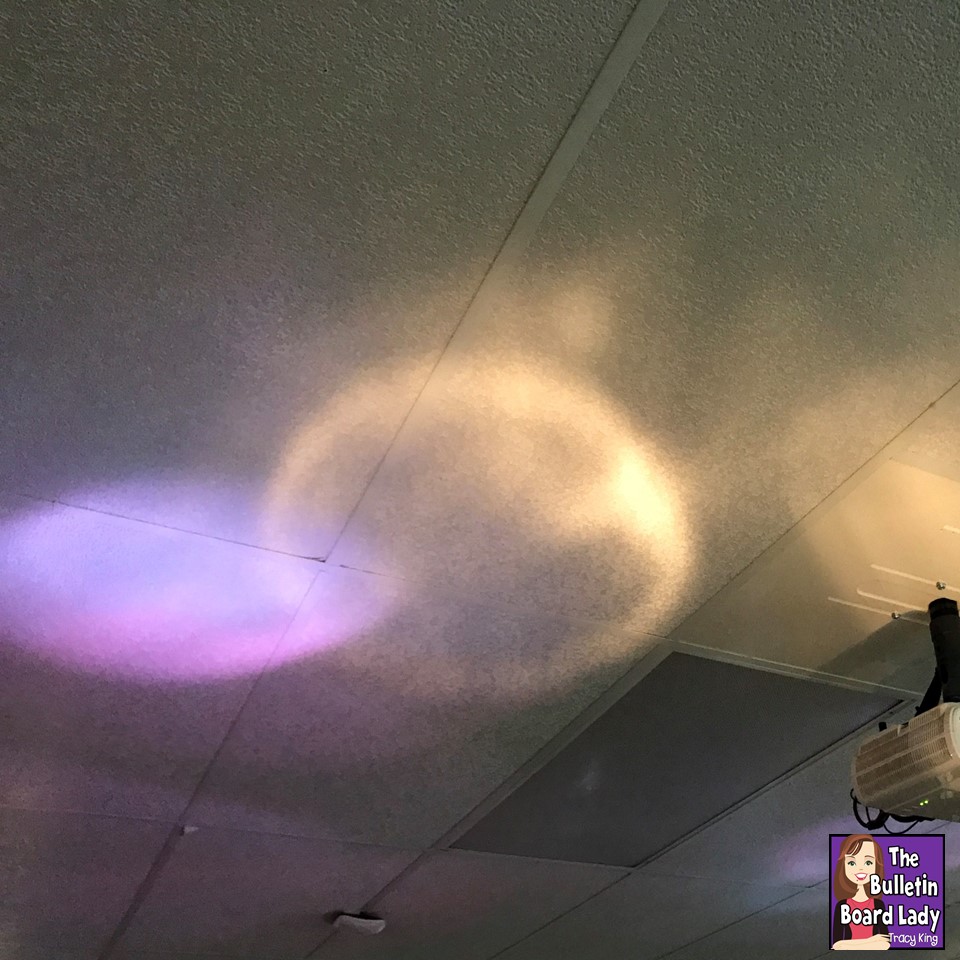
When using the flashlights sitting down, you get a large light on the ceiling.  It's pretty, but not very distinct or clear if your room isn't completely dark.  In the picture above you can see what it looks like when students are sitting.  In the picture below students were standing.  That produced a smaller, cleaner look to their light and it looked much better when we were all working together.

You could always buy smaller flashlights with a stronger beam to get the same effect.

Flashlight routines in music class can be used to reinforce form and keep students engaged and excited about learning.  This post shares routines for "Cantina Band" by John Williams and "March" from the Nutcracker as well as tips and tricks for using them successfully in your music classroom.

Teaching Form
Before putting flashlights in their hands we listen to the piece of music.  We either follow a listening maps or we listen and create our own listening map.  This gives students the experience they need to be successful when they get the flashlights.

We label each section with a letter name and decide on an action for the flashlight.

Flashlight routines in music class can be used to reinforce form and keep students engaged and excited about learning.  This post shares routines for "Cantina Band" by John Williams and "March" from the Nutcracker as well as tips and tricks for using them successfully in your music classroom.

Flashlight routines in music class can be used to reinforce form and keep students engaged and excited about learning.  This post shares routines for "Cantina Band" by John Williams and "March" from the Nutcracker as well as tips and tricks for using them successfully in your music classroom.

This video is of one of my 5th grade classes and their first attempt at a flashlight routine to "Cantina Band".  This is an unedited, imperfect, completely authentic look at how this works in my classroom.  I love how at section D they are in awe of their own awesomeness!


Flashlight routines in music class can be used to reinforce form and keep students engaged and excited about learning.  This post shares routines for "Cantina Band" by John Williams and "March" from the Nutcracker as well as tips and tricks for using them successfully in your music classroom.

I hope this inspires you to try using flashlights in your classroom.  Do you have any favorite pieces that would work well with flashlights?  I would love to learn about them.  Let me know in the comments.

Flashlight routines in music class can be used to reinforce form and keep students engaged and excited about learning.  This post shares routines for "Cantina Band" by John Williams and "March" from the Nutcracker as well as tips and tricks for using them successfully in your music classroom.


post signature

Movement Ideas for "Those" Days


It can happen during the week before Christmas, the days before Spring Break or during each and every sunny day in May.  Your students come to music class with an overabundance of energy and a deficit of attention.  It is tough for them to concentrate and they need to move!  In this post I'll share some of my favorite wiggly activities to get through "those" days: creative movement, watch and wiggle and dance party.

Creative Movement

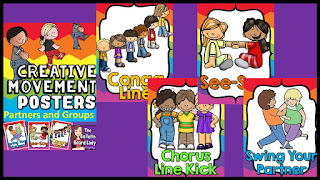
I've been using these posters for quite some time.  Last year I turned them into something a little prettier and now have several sets in my TpT store.  These movement sets each have a theme and come with two different activities:  Freeze Dance and Creative Movement.  Freeze Dance is probably self explanatory, but the creative movement cards may need a little more explaining.
I either project the file or print it out and just hold the posters up while students dance.  I actually prefer printing them out so that I can come back to a really fun move over and over.  I start the music (Suggestions are included, but almost anything works!) and then hold up a creative movement poster.  Students look at the picture and/or the name on the card and then decide how to interpret it.  This is SO much fun that kids ask for it every week.  Sometimes I mix and match the sets to keep them on their toes.  Here are a few samples from different sets:


 You can click each of these pictures to learn more about the sets.

Watch and Wiggle

Teacher Confession #1:  Sometimes, especially at the end of the school year, I just need to sit down for a few minutes.  I need to sit and rest because there is just no tired like end-of-the-year-tired.  For me, it is a great time to pull out my watch and wiggle videos.
Teacher Confession #2:  I have quite a few student favorites saved on Symbaloo and until this day, I have never shared my list with anyone.  Why?  This visual playlist ups my cool factor by about 50 degrees.  Kids love it that much.  So, be careful and use it wisely.  :-)
Click here to check out my Movement and Dance Symbaloo board with links to some of my favorite wiggly songs.

Dance Party

This is the most exhausting but exhilarating options for "those" days.  It is time to wear them out with an all out dance party! WooOoOooT!  On dance party days (or days where the last half of class is a dance party), I have students stack their chairs and leave a ton of open space.  We talk about acceptable dance behavior, personal space and rule #2 in the music room "Don't touch Mrs. King's stuff!"

Then, we dance.  I usually dance with them as they need a leader for some of the dances.  Here are some of our favorites:
Cha Cha Slide
Macarena
Cupid Shuffle
Chicken Dance
The Bunny Hop
C'mon Ride the Train (Here's a great tutorial.)
The Hokey Pokey (Yes, even with the big kids!)
Watch Me (Whip/Nae Nae)
Next dance party I'm going to try:
The Wobble (Tutorial here.)
The Cotton Eyed Joe (Tutorial here.)

Warning:  This option can be pretty exhausting, but I must admit that I always feel better and sleep really well that night!

post signature

Music Class and Halloween

Music class and Halloween can be a BOOtiful thing!  Learn about ways to get your students moving, thinking and creating with ideas like Pass the Pumpkin, There’s a Spider on My Head, Pumpkin Patterns, Jazzy Jack-o-Lanterns and more!  Your elementary music students will be “howling” with delight!

Can I tell you a secret?  I have not always been a fan of Halloween.  I’m not really sure why, but I’ve come around and now feel comfortable teaching a Halloween song or two.  As I prepare lessons for my K-6 classroom I try to incorporate songs and activities that feel like Halloween without being too scary or creepy.  We do many songs about pumpkins and spiders and so on.

At one district we avoided everything Halloween and even called the classroom celebrations on that day “Fall Parties”.  At another school we celebrate with a big parade, all students and most staff members dress up and hang decorations in our classrooms and on bulletin boards.  You probably know which end of the spectrum your district falls into and can adjust some of the activities below to suit your needs.

Below you’ll find a small compilation of ideas for October and some fun ideas for Halloween in the music room.
Music class and Halloween can be a BOOtiful thing!  Learn about ways to get your students moving, thinking and creating with ideas like Pass the Pumpkin, There’s a Spider on My Head, Pumpkin Patterns, Jazzy Jack-o-Lanterns and more!  Your elementary music students will be “howling” with delight!

There’s a Spider on My Head
This fun song is great for Kindergarten and First Grade.  It is sung to the tune of “If You’re Happy and You Know It”.  I start by modeling this song, but honestly by the time I get to verse three they can’t resist singing along, pausing to hear the new part of the verse.  Because this song isn’t specifically a Halloween song, I often tie it into the change in the weather and how spiders and flies want to come in to our warm houses instead of staying out in the cold.  This gives us an opportunity to sing the song another day.  The second time we’ll make up new (and often sillier) verses.

Music class and Halloween can be a BOOtiful thing!  Learn about ways to get your students moving, thinking and creating with ideas like Pass the Pumpkin, There’s a Spider on My Head, Pumpkin Patterns, Jazzy Jack-o-Lanterns and more!  Your elementary music students will be “howling” with delight!


Pumpkin Patch
Music class and Halloween can be a BOOtiful thing!  Learn about ways to get your students moving, thinking and creating with ideas like Pass the Pumpkin, There’s a Spider on My Head, Pumpkin Patterns, Jazzy Jack-o-Lanterns and more!  Your elementary music students will be “howling” with delight!

This is a fun song to sing with 1st and 2nd Graders.  We learn the song by rote adding actions with each phrase.  Next, we sing and move with a partner. 

Pumpkin Patch Lyrics
Pumpkin patch, Pumpkin patch.  Looking for a pumpkin in a pumpkin patch.
Here is one, nice and fat.  Turn into a Jack-o-lantern, just like that.

Pumpkin Patch Tune
Sol sol mi, sol sol mi, do do do re mi mi sol fa mi re do.
Sol sol mi, sol sol mi, do do do re mi mi so fa mi re do.

Pumpkin Patch Actions: 
“pumpkin patch” =clap hands twice on “pumpkin” and in the air on “patch”.  Later transfer the air clap to a partner’s hands.  Do this for every “pumpkin patch” in the song.
“looking for a pumpkin”=Put hand over eyes and on your forehead as though you are shading your eyes
“here is one” =right hand out as though you were hugging a giant pumpkin
“nice and fat” =left hand joins the right as though you were hugging the giant pumpkin with two hands
“turn into a Jack-o-lantern” =turn around with arms still outstretched.  Later join hands with a partner and turn in a circle.
“just like that” = clap clap air pat (that later becomes a partner clap)


Music K-8 Songs
I just love Plank Road Publishing!  My kids really connect with my kids and they are easy to sing.  This is a list that I use 2nd through 6th grades.  Here are a few of my favorites for October:
Eight Legs (We actually sing this one all year round.)
Halloween Rap  (The groove on this one is too cool!)
The Apple Song  (LOVE this catchy tune that names a bajillion different apples.)
Dweller of the Cave (Spooky and mysterious, it leads to great conversations about what the dweller could be.)
Hey Jack  (A favorite of my 5th and 6th graders.)
Pumpkin March (Mostly for the younger crowd, this is great for teaching dynamics.)
Mwa Ha Ha  (Seriously, can’t stop singing this one.)

Scarin’ Alive (Disco grooviness is alive!)

Sing Along Videos
I have a Symbaloo page with some of the songs we might add at the beginning or end of class if we have time.  They are short and simple and are probably most useful for 2nd grade or younger.  The link to this Symbaloo page is at the bottom of this blog post.

Music class and Halloween can be a BOOtiful thing!  Learn about ways to get your students moving, thinking and creating with ideas like Pass the Pumpkin, There’s a Spider on My Head, Pumpkin Patterns, Jazzy Jack-o-Lanterns and more!  Your elementary music students will be “howling” with delight!

Jazzy Jack-o-Lanterns
Such fun!  I don’t always do this each fall, but it always seems to work its way in for at least one grade level do to an oddity in scheduling or special events.  Often I’ll do this activity during the week of parent teacher conferences with the one class that I will see from a specific grade level.  Students use the chart that I give them with music symbols to create an interesting jack-o-lantern face.  They can use them in any fashion, upside down and in any color.  I walk around while they are working on them and quiz them on the names of the symbols or explain what they are if they are new to them.

Music class and Halloween can be a BOOtiful thing!  Learn about ways to get your students moving, thinking and creating with ideas like Pass the Pumpkin, There’s a Spider on My Head, Pumpkin Patterns, Jazzy Jack-o-Lanterns and more!  Your elementary music students will be “howling” with delight!

I have a bulletin board kit for this project too.  It looks great mixed in with the student projects.  The chart that I give them is in this kit too.
Music class and Halloween can be a BOOtiful thing!  Learn about ways to get your students moving, thinking and creating with ideas like Pass the Pumpkin, There’s a Spider on My Head, Pumpkin Patterns, Jazzy Jack-o-Lanterns and more!  Your elementary music students will be “howling” with delight!

Candy Corn Puzzles
Music class and Halloween can be a BOOtiful thing!  Learn about ways to get your students moving, thinking and creating with ideas like Pass the Pumpkin, There’s a Spider on My Head, Pumpkin Patterns, Jazzy Jack-o-Lanterns and more!  Your elementary music students will be “howling” with delight!

I do centers at least once every four times I see students so seasonal workstations are so much fun!  With the Candy Corn Puzzlers I actually had the whole class do the same puzzles in small groups.  Fourth graders worked pitch names, 5th grade worked on recorders, etc…  I allowed about 10-15 minutes for this activity including the time it took us to break into groups and get supplies.  If you have the puzzles in a little baggie you could probably do this in less time.

 Recorder Candy Corn Puzzlers Dynamics Candy Corn Puzzler


Pumpkin Patterns
This is a quick and easy game to create and to play.  It is essentially a matching game.  The pumpkins have four-beat rhythms on the back side of the jack-o-lantern.  I created a duplicate of each pattern so that students could match them up.  I created this set specifically for what fourth graders would know this time of the year.  You could create multiple sets that were usable with more than one grade level.  Students turn the pumpkins so that the rhythms are face down and take turns turning over pairs of pumpkins.  If they find a match, they keep it.  The person with the most matches wins the game.  Often they will have time to play multiple times before our time is up.
Music class and Halloween can be a BOOtiful thing!  Learn about ways to get your students moving, thinking and creating with ideas like Pass the Pumpkin, There’s a Spider on My Head, Pumpkin Patterns, Jazzy Jack-o-Lanterns and more!  Your elementary music students will be “howling” with delight!


Music class and Halloween can be a BOOtiful thing!  Learn about ways to get your students moving, thinking and creating with ideas like Pass the Pumpkin, There’s a Spider on My Head, Pumpkin Patterns, Jazzy Jack-o-Lanterns and more!  Your elementary music students will be “howling” with delight!

Ideas to Shake Your BOOty  (see what I did there? *grin*)
Oh my goodness!  This set of creative movement cards is so much fun!  I turn on some awesome seasonal songs and then hold up the posters for students to imitate.   It is so fun to see students do the “The Broom Dance” or the “Zombie Wobble”.  The idea is that students get to interpret the move named on the poster in any reasonable way.  Wow!  What creativity!   In this set there is also a freeze dance setof posters too.  If you like them, I have several more themes that you can use.  They are also fun to mix and match.

 Here are some of the songs I like to use for this activity:
“Monster Mash” by Bobby “Boris” Pickett
“Ghostbusters” by Ray Parker Jr.
“Purple People Eater” by Sheb Wooley
“Stayin’ Alive” by the Bee Gees
“Thriller” by Michael Jackson

Pass the Pumpkin
I buy a bag of mini pumpkins at Walmart each year for Pass the Pumpkin.  I divide students into small groups of 4-6 and we say the pattern “Bounce, 2, 3, Pass”.  This allows students to pass every four beats.  This is fun for Kindergarten and 1st.  With older students we make the pattern shorter with “bounce, pass” or “pass, pass, pass, pass” on each beat.  The word “bounce” doesn’t actually mean bounce it on the floor!  Messy!  It means to bounce it in the air to show the beat.

Here’s a video of a 1st grade group from a long time ago.  This was their first attempt at “bounce, pass, bounce, pass”.  *giggle*  Not perfect, but certainly fun!


Dance Videos
I think it is so important to keep kids moving so I have several go to movement activities and videos.  I’vegrouped some of the Halloween videos on a Symbaloo page.  You’ll also find the links to a few sing along songs for the lower grades.  Enjoy!

 Mrs. King's Halloween Symbaloo


post signature

Steady Beat Swords

Pool noodles magically transform into light saber inspired steady beat swords in Mrs. King’s Music Class.  This DIY classroom project is easy to do and keeps students engaged and learning.  What do you do with them?  Read on for ideas and video examples.

Welcome to another edition of Summer Project Sundays.  Last week I posted pictures of my ponies, my pool noodle ponies.  This week I'm sharing another project with noodles because they seem to be everywhere this time of year!

I suppose my inspiration for pool noodle swords is quite evident.  Have you ever seen a bunch of kids using them in the pool?  They make a great weapons!  LOL.  Okay...don't tell my kids I said that!  I loved the sound that they made when whacked against each other and new my students would as well.

Pool noodles magically transform into light saber inspired steady beat swords in Mrs. King’s Music Class.  This DIY classroom project is easy to do and keeps students engaged and learning.  What do you do with them?  Read on for ideas and video examples.

To make the noodle swords you'll need a sharp knife.  I used a chef's knife.  It has a 
smooth, large blade.  It was very easy to cut through each of the pool noodles.  I cut each noodle in half (or as close to half as I could guesstimate).

Next, using shiny silver duct tape and regular black duct tape I created handles for each of the swords.  I didn't worry about being precise and tore the tape rather than trying to cut it. 

For best results, put a piece of tape on the bottom of the noodle to cover the hole, then cover about 5 inches or so with the same color.  Tear a couple of rectangles to put on each side of that as a "button" to turn the swords on when they become light sabers.  I also went back and added a trim of black or silver when they were all finished.  I just wanted to make sure I had enough tape before embellishing.  I made 24 noodles with 2 rolls of tape.

Pool noodles magically transform into light saber inspired steady beat swords in Mrs. King’s Music Class.  This DIY classroom project is easy to do and keeps students engaged and learning.  What do you do with them?  Read on for ideas and video examples.

In my classroom they were stored in a large laundry tub with handles until I found a sturdy basket that worked well.  

I use them for several different movement activities with K-2, but my favorite activity works for K-6.  My fifth and sixth graders LOVED learning about the music of John Williams.  At the end of our John Williams studies we used the pool noodles or "Steady Beat Light Sabers" to explore the form of "Imperial March".   You can read about some of the John Williams activities HERE.

Before we start with this activity, I pass out the swords and explain that even one single attempt to use the steady beat sabers to hit or poke another person will cause them to be retired.  No one wants to miss out on the opportunity to play with swords in music class so behavior is EXCELLENT during this activity.

Here's a silly little thing I do before we begin.  The video shows a group of third graders.


Silly, right?  The kids love it!

Before we listen to "Imperial March" we discuss how composers use music to represent characters in stories.  We'll talk about Peter and the Wolf and the motif used for the wicked witch in The Wizard of Oz.  I'll ask them to raise their hand as soon as they know what character is represented by the music.

Hands shoot in the air as the main theme of "Imperial March" starts.  I'll explain that when we get our steady beat light sabers that we'll keep the beat with a partner when we hear the theme and then we'll pretend to be jedi knights and sneak around the room looking for bad guys.  When they hear the theme again, they should find their partner and keep the steady beat again.  For older classes, I'll encourage them to find an advanced way to keep the steady beat.

This might mean tapping the swords together high and then low, using both hands or even adding a little turn.  Such fun!  Here's a clip from a 5th grade group.


Some classes also use the swords for a play along.  I found this little gem while looking for something else on Youtube.  The link takes you to a SafeShare version that I use in the classroom.  I like not having to worry about what may pop up at the end of the video.

I hope you enjoy making steady beat swords or steady beat light sabers this summer!  Let me know of some ways you use them in your classroom.  My kiddos will LOVE more opportunities to play and learn.
Pool noodles magically transform into light saber inspired steady beat swords in Mrs. King’s Music Class.  This DIY classroom project is easy to do and keeps students engaged and learning.  What do you do with them?  Read on for ideas and video examples.


post signature

Pool Noodle Ponies: What to do with Your New Herd


Hurray for summer!  If you are a teacher, it means a slightly slower schedule but many projects.  My summers are filled with professional development, college classes, designing next year's classroom (I'm sure that I'll totally get it perfect riiiiiiiight before I retire.) and working on the projects I just couldn't squeeze in during the school year.   Join me during June and July for Summer Project Sundays.  This series of blog posts will inspire you to get started on a few projects of your own.  
A few years ago I posted  about how to create Pool Noodle Ponies.  Check out that post HERE to learn how to create these adorable creatures!  Last summer I gained an entire herd of noodle ponies.  I had been in a car accident, so I really just supervised their construction.  My fabulous sister in law manned the pony factory and created them.  We decided to use a western themed duct tape to bind them together.  I love how that turned out!


Now that you have created a herd of noodle ponies, what can you do with them?  Here are a few ideas:

1.  This is the Way We Walk Our Horse
You know that song "Here We Go 'Round the Mulberry Bush"?  It is used as a nursery rhyme reminder of daily chores (Monday=wash the clothes, Tuesday=iron the clothes, Wednesday=mend the clothes, etc...).  You may have learned this version in elementary school.  Check out this link to learn about pioneer living and daily chores.

This song transforms into a perfect pool noodle pony song!  Take a look at a video of some of my Kindergarteners using their ponies with this song.


Fun, right?  This is an adaptation of an activity by the amazing Artie Almeida.  Here are some of the lyrics we use:
1.  This is the way we walk our horse
2.  This is the way we pet our horse
3.  This is the way we trot our horse
4.  This is the way we water our horse
5.  This is the way we jump our horse
6.  This is the way we feed our horse
7.  This is the way we race our horse
8.  This is the way we brush our horse
9.  This is the way we trade our horse (Chaotic but fun!)
10.  This is the way we stable our horse (put horses back in their tub "stable")
2.  Act Out Horse Songs
A couple of my favorite are "10 Little Horses" (think 10 Little Indians) and "Trot Old Joe".
Trot Old Joe
Trot old Joe, trot old Joe,
You ride better than any horse I know.
Trot old Joe, trot old Joe
You're the best horse in the country, oh
Whoa, Joe!
We keep the steady beat on our laps like singing.  Then we change the lyrics so that old Joe can walk, run, jump, skip, dance etc...  After learning this song it is great fun to act it out with the pool noodle ponies.  It's a great way to talk about tempo and it creates a memorable experience for your kiddos.
3.  William Tell's Overture
Who doesn't love this classic?  I've done it with instruments, with movement, with manipulatives and now with noodle ponies.  Create a listening map for this piece (or use the fabulous one in Artie Almeida's "Parachutes, Ribbons and Scarves, Oh My".  On the "A" section, ponies trot in a circle.  Use instruments or other movement during the other sections. 
4.  Wild Donkeys (from Carnival of the Animals)
This quick little piece (called "Wild Asses" in most translations) is perfect for getting the wiggles out with a noodle pony ride.   I have about 8 students line up with their ponies.  Four students on one side of the room and their partner on the other side.  Students switch places with their partner by galloping with their noodle.  They start when the music starts and stop when the music stops.

This activity is usually used with several Carnival of the Animals activities.  Read more about those HERE.  We talk about tempo, but don't really analyze the piece.  I use it more as an opportunity for them to get to hear the piece over and over in an exciting way.  When we go back to listen to the pieces from CofA they really know this one!

Here's a clip from one of my classes:

There are many other ways to use the ponies in your classroom.  If you've used them, I would love to hear about it or see pictures.


post signature

How to Make 300 Ribbon Streamers for $10


I'm cheap.  There.  I said it.  Well, maybe I should say that I'm "thrifty".  As a music teacher I am always looking for great deals on all sorts of odd things.  I've been on the hunt for rubber ducks, plastic axes, coon skins, plastic fruit, bottle caps, icing lids, cutting boards and more items that may seem a little unusual for the classroom.  When I can make one of these unique items I certainly do.

For my non-concert program this spring we are going to do an activity with ribbon streamers.  I need enough for all of my third and fourth graders and at least one of their parents.  I guesstimated about 300.  To purchase ribbon streamers, I would have to spend more than a thousand dollars!  YIKES!

Instead of that, I spent about ten bucks.  The kids love them and they are actually pretty sturdy.  I have a classroom set that I made about 7 years ago that are still in great shape.  The streamers are made from unsharpened pencils and plastic tablecloths.  Here's what to do:

1.  Call a local business and ask for a donation of unsharpened pencils.  It's advertising for them and a money saver for you.  If you can't find any you could substitute chopsticks or dowel rods.  My pencils look like money because a local bank donated them.  My older set is just a plain white pencil with no eraser. 

2.  Purchase several rectangle shaped plastic tablecloths.  I don't have an exact number for you, but I was able to make 28-35 streamers out of each one.  I wasn't very concerned that they were uniform in size, so it varied for me.  Choose several different colors for added interest and for more variety in the kinds of activities they can be used in.  These were $ .97 each at Walmart


3.  Cut the tablecloths into strips.  I folded the tablecloths so that I would be cutting the width of the tablecloth.  (This is the shorter side.)  Cutting it longways creates a ribbon that is too long for most of my kiddos.  Cut the strips about 2-3 inches wide.  It is not likely that the strips will be even and straight unless you cut very precisely.  I just called them whimsical, shrugged my shoulders and moved on.


4.  Unfold one of the strips and add a piece of tape about the same size as the ribbon on the end.

5.  Tape this to the end of the pencil with a little bit of tape hanging over.

6.  Roll the pencil toward the ribbon until it touches the other side of the tape.

7.  Roll the entire ribbon up and you have a streamer that is ready to use!

What kind of things do I do with these?  I'll post more ideas soon but for now you might want to check out these visuals for using ribbons, scarves and streamers in music class.  It makes activities easy and fun!

Want some more great ideas that work for real teachers?  I'm linking up with Mrs. Miracle's Music Room to share even more ideas with Worked for Me Wednesday.  Follow the link to see more great ideas!


post signature