Header

Mrs. King at Home About Mrs. King Contact Mrs. King Mrs. King's Music Class HOME Image Map
Showing posts with label 6th grade. Show all posts

Rhythm Cards for Rockin' Repetition


Use these simple rhythm cards to establish routine and improve rhythm and steady beat skills in your music classroom.  In music education the simplest ideas are the best. Your students will thank you for adding this activity to your music routine.


I love creating a routine at the beginning of my classes.  It helps students focus and gives me a second to handle questions and get things ready to go.  For some classes this is a hello song, echo clapping or a movement activity.  In this post I'll share one of my favorites.  Rhythm cards are the perfect way to get students thinking and moving in music class.

The rhythm cards that I am referring to have 4 beats worth of notation.  I copy the same card on front and back so that they are easier to use. One card has 4 quarter notes.  Another has two half notes and so on.

When using these cards I am reinforcing note values and sharpening skills that we will use in other activities to compose rhythmic ostinatos or melodies.  Students are able to feel the duration and this makes a strong connection.  Using this activity at the beginning of each or during each class for several weeks in a row has been a great skill builder!  I like to call it "rockin' repetition".

Use these simple rhythm cards to establish routine and improve rhythm and steady beat skills in your music classroom.  In music education the simplest ideas are the best. Your students will thank you for adding this activity to your music routine.


I wish this simple but brilliant idea was mine, but I actually learned about it from Kristin Lukow, music educator extraordinaire on the Music K-8 discussion list.  I've incorporated it into lessons for many years now and my students are better for it.  Thanks Kristin!

Here's what I do:
I choose a song with a medium to fast beat (which are much easier than slower songs) and start it as students are walking into music class.  They clap the pattern as an ostinato until I change the card.  That's really it!

Use these simple rhythm cards to establish routine and improve rhythm and steady beat skills in your music classroom.  In music education the simplest ideas are the best. Your students will thank you for adding this activity to your music routine.


This activity works great with my drums, classroom percussion instruments and different kinds of body percussion instead of just clapping.  Often we will do this with tennis balls or basketballs (if I can borrow some).  When we use balls with the cards here are the movements:

whole notes - count as you move it around your waist, back and then to your front.  Think of it as traveling around the world.
half notes - bounce so that the first part of the note is when the ball hits the floor and the second is when you catch it
quarter notes -same as half note but on each beat.  It helps to be closer to the floor for this one.
eighth notes-hot potato!  We pass it from hand to hand in rhythm.

Since this activity is used many times during the school year my play list is pretty diverse and always growing.  I include songs that I'll use with tennis balls, basketballs and with body percussion.  I can choose faster pieces for body percussion than the others.  Some student favorites:

"Can't Stop This Feeling" by Justin Timberlake
"Song of the South" by Alabama
"The Star and Stripes Forever" Sousa
"Best Years of Our Lives" by the Baha Men
"I Love a Rainy Night" by Eddie Rabbit

You can check out my entire playlist for rhythm cards here:  Rhythm Cards Playlist on Amazon Music.

I know this is a simple idea, but once you've implemented it I think that you'll find it  is helpful not only for establishing routine, but for improving rhythm skills and steady beat with your students.  I'm so sure it will that I want you to have a copy of the cards for free!  Print out two copies and laminate the same pattern back to back.  Get the cards here: Rhythm Cards for Rockin' Repetition


Use these simple rhythm cards to establish routine and improve rhythm and steady beat skills in your music classroom.  In music education the simplest ideas are the best. Your students will thank you for adding this activity to your music routine.


post signature

Sub Plans for the Non-Musical Sub

Music teachers often need to leave sub plans for non-musical substitute teachers.  This post is filled with tried and true lesson plans that are practical and comfortable for any teacher that steps into the music classroom.  Children's books, videos, worksheets and more are discussed.

It happens.  A kid gets sick.  Your car breaks down.  You are suddenly called to go out of town.  The flu wraps its icy fingers around you.  You need a sub.

As a music teacher, I can't always count on getting a musical substitute teacher.  Actually I have only rarely had a sub that was comfortable doing musical activities like singing, dancing or playing instruments.  Due to this fact, I have created a sub tub with activities that even a non-musical sub would be comfortable teaching.

Currently I am teaching 3rd, 4th and 5th grades but I have used this system with K-8 quite successfully.  I organize all of my instructions for the substitute teacher in a binder.  Here are some of the things that are helpful to include:
  • Where to find things like the attendance book, seating charts, office supplies, bandages, hall passes, nurse passes, etc...
  • Procedures for emergencies.  If your school uses code words or special signals, be sure to include those in your plans.
  • Instructions for using technology in your room and any passwords that they will need.
  • A list of helpful teachers and where to find them.
  • A picture or drawing of how you set your room up.
  • An explanation of how to follow your emergency plans if no other plans are left.
  • General rules for the music room.  I have flexible seating choices in my room but I only use them for workstations or movie days, so I want to let them know how I use them.
  • Change for the soda machine. 
This is the first thing a guest teacher to my classroom needs to read to get acquainted with the music room and how their day will go. 

The sub plan binder also contains several different lesson plans for each grade.  These plans include a list of what they will need, where it is, what to do and a tracking sheet that I ask them to fill out so that I know what they have done and with which classes.  Keep reading to find out how to get these starter files for free!
Music teachers often need to leave sub plans for non-musical substitute teachers.  This post is filled with tried and true lesson plans that are practical and comfortable for any teacher that steps into the music classroom.  Children's books, videos, worksheets and more are discussed.

When I return from an absence I can quickly browse through the binder and see what students have done.

The binder refers to materials in the sub tub.  These materials are either videos (some with worksheets, some without), worksheets or activities with children's books.  

Music teachers often need to leave sub plans for non-musical substitute teachers.  This post is filled with tried and true lesson plans that are practical and comfortable for any teacher that steps into the music classroom.  Children's books, videos, worksheets and more are discussed.


Videos
Here are some videos that I recommend for the sub tub:

Kindergarten and 1st Grade:
Wee Sing Train
Wee Sing King Cole's Party
Wee Sing Big Rock Candy Mountain

2nd Grade:
Wee Sing in Sillyville
Wee Sing Marvelous Musical Mansion
Tubby the Tuba
3rd Grade:
Wee Sing Marvelous Musical Mansion
Overture to Disaster
Music and Heroes of America
Julie's Green Room (on Netflix)

4th and 5th Grades:
Stomp Out Loud
Composer's Specials (Bach, Bizet, Liszt, Strauss, Rossini, Handel)
Beethoven Lives Upstairs


Videos with Worksheets
I have created several resources that you might find valuable for your sub tub.  They are all actually bundled up in one bundle in my store (or you can purchase them individually).  Check out this Musicals Mega Bundle which includes tons of resources for these musicals:


Worksheets
I'm not a big fan of worksheets, but they do have their purpose and place in music class.  For substitute teachers they are often a familiar and comfortable activity that they can be successful with.  In my sub tub I use worksheets that reinforce skills we are constantly working on like note values, pitch names, composition and instrument identification and classification.

I pull those worksheets from the same sets that I have posted in my store.  They come in a bundle (that continues to grow) or you can buy the sets individually.  There are more than 400 usable pages in the bundle.  You can get it here:  No Prep Music Worksheets Endless Growing Bundle

Music teachers often need to leave sub plans for non-musical substitute teachers.  This post is filled with tried and true lesson plans that are practical and comfortable for any teacher that steps into the music classroom.  Children's books, videos, worksheets and more are discussed.

Activities with Children's Books
Like many elementary music teachers I LOVE teaching with children's picture books.  I have dozens of books that I use regularly and some that work really well with substitute teacher lesson plans.

The Remarkable Farkle McBride by John Lithgow
This is such a fun story!  I have students complete a writing prompt that asks them to draw and write about an instrument they might like to play.  This book is also a great time to talk about onomatopoeias so we take time to write down some musical onomatopoeias.

The Word Collector by Peter H. Reynolds
This book is relatively new to my collection.  It's a delightful story about a boy who collects words.  After the story, students go on a word hunt around the music room to collect words.  This is also a great time to use some of the syllable search worksheets from my worksheet collections.
Music teachers often need to leave sub plans for non-musical substitute teachers.  This post is filled with tried and true lesson plans that are practical and comfortable for any teacher that steps into the music classroom.  Children's books, videos, worksheets and more are discussed.
Tubby the Tuba by Paul Tripp
This is such a wonderful story!  In recent years I have stopped showing the movie very often.  It feels like it is 4 hours long.  The book, however, is delightful and not four hours long.  Subs love this lesson too!  After the story, I leave some discussion questions and a color the orchestra worksheet (color by instrument family) and a word search.

Moses Goes to a Concert by Isaac Millman
Another sub favorite is Moses Goes to a Concert.  This book talks about the experiences of a deaf student that goes to hear an orchestra perform.  The percussionist in the orchestra is also deaf and helps the students experience the music through vibrations.  With this book I leave a listening comprehension worksheet and a copy of the ASL alphabet.  After the worksheet questions have been answered and discussed, students can use the alphabet sheet to practice their names.  There are also TONS of YouTube videos of people signing popular songs that students love to watch.

The Rocket's Red Glare by Peter Alderman
This book tells the story of the "Star-Spangled Banner".  Although there are several books out there, this one has such beautiful illustrations that it is quickly becoming my favorite.  For sub plans, I have the teacher read the book, discuss the etiquette that we should display during the national anthem and then listen to the version that comes with the book.  After that, students receive sheets that are mostly blank with the exception of one of the phrases of the the "Star-Spangled Banner".  Students are then challenged to illustrate their phrase.  When they are finished it makes a beautiful display for the hallway or a bulletin board.

I have all of my children's literature sub plans bundled in my store.  Included are the ISBN numbers for the books, links to any pertinent videos to show as time fillers and all of the worksheets and activities listed about.  Get it here:  Sub Plans for the Non-Musical Sub

You might also like to watch this replay of a Facebook Live video where I take you on a tour of my sub binder and sub tub resources.


Ready to build your sub binder and Sub Tub?  Download these free starter files:  Sub Plan Starter Files

Like these ideas?  PIN them for later!
Music teachers often need to leave sub plans for non-musical substitute teachers.  This post is filled with tried and true lesson plans that are practical and comfortable for any teacher that steps into the music classroom.  Children's books, videos, worksheets and more are discussed.


post signature

Take Music Class Outside

Outside activities for music class can be just as engaging as activities that you plan for inside the music room.  Sing, dance, play and assess in the sunshine.  Nine practical ideas for beautiful days in music class.

Take your music classes outside!  No, not just for an extra recess.  Take them outside for an extra special music class!  When the days are sunny and warm, you can go outside to sing, dance, play and even assess.  Here are 9 practical ideas for beautiful days.

Outside activities for music class can be just as engaging as activities that you plan for inside the music room.  Sing, dance, play and assess in the sunshine.  Nine practical ideas for beautiful days in music class.

1.  Musical Hopscotch
There are plenty of ways to play musical hopscotch.  With a little sidewalk chalk, create a hopscotch board.  What you put inside each square depends on what skills you want students to practice.

Note Values:  Draw note with values from smallest to largest on the blocks if you wanted to work on note values. Students would pause on each block as they counted the notes or said the syllables.  Add multiple notes to get all the way to ten or create a hopscotch board in a different shape to accommodate your needs.
Solfege:  I created a hopscotch board (pictured above) with the syllables of a major scale.  I added sol and do in the spaces of 9 and 10 on the board.  To warm up, we hopped and sang the syllables ascending and descending.  Then the game started.  Students would roll their rock and skip whatever syllable it landed on.  They hopped through the board singing each syllable except the ones that were covered.  This game was challenging and so much fun.  What I discovered was that when I wasn't actively engaged with a group, their singing skills weren't very strong.
Pitch:  I haven't tried this with students but I would love to try a version where some students jumped and other students played corresponding Boomwhakers.  That would be lots of fun too!

Outside activities for music class can be just as engaging as activities that you plan for inside the music room.  Sing, dance, play and assess in the sunshine.  Nine practical ideas for beautiful days in music class.

2.  Treble Clef Twister
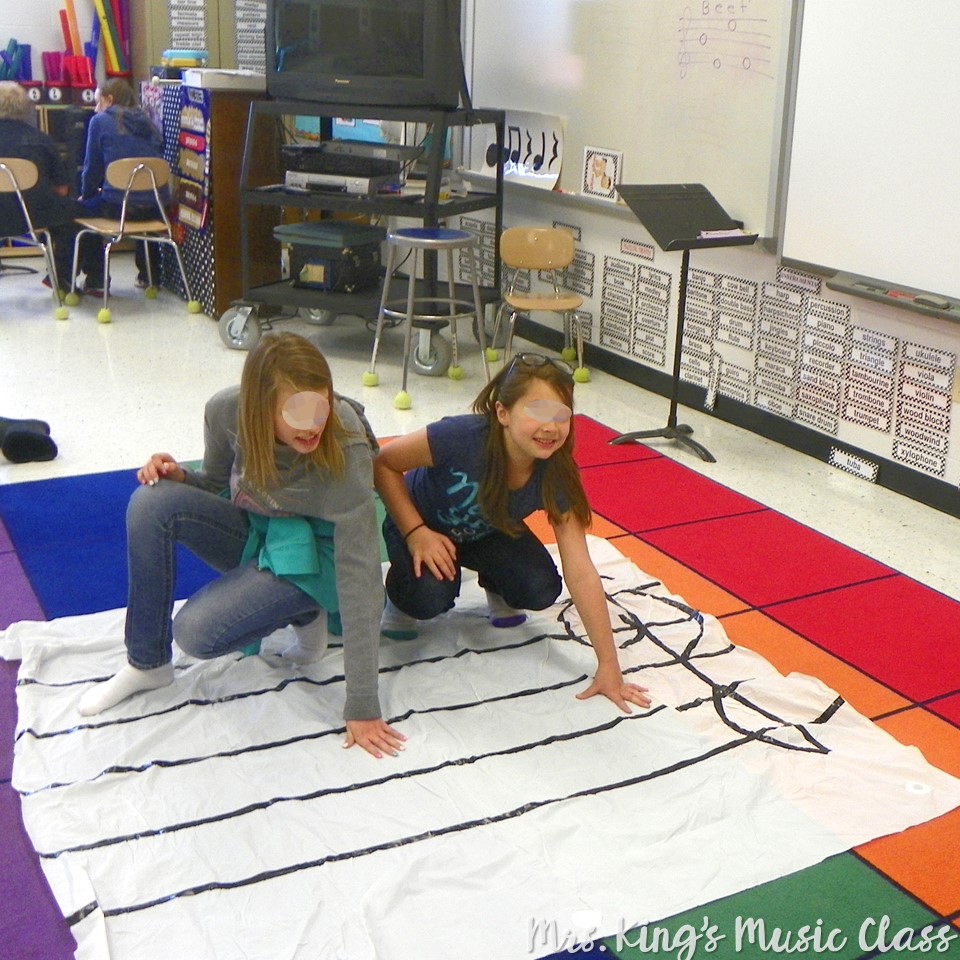
When I play Treble Twist Up in class, I use a shower curtain that I have created a treble clef staff on and students take off their shoes and play the game like regular Twister.  Outside the shower curtain could work, but it wasn't a different enough experience in my mind.  If you have a playground that has the large foam squares as the "floor" of the playground you could create a treble clef staff with chalk on it to play.  Another idea is to spray paint the staff onto a grassy area.  The next time the grass is mowed, the staff is erased.  (You might want to get permission before you do this!)  Add THIS spinner and you have a great outside game that reinforces pitch names.

Outside activities for music class can be just as engaging as activities that you plan for inside the music room.  Sing, dance, play and assess in the sunshine.  Nine practical ideas for beautiful days in music class.

3.  Yard Dice - Roll and Cover
I needed an excuse to buy a set of LARGE wooden dice.  *giggle*  Outside music class seems like a great reason!  I must confess that I already have a collection of large foam dice that I use inside and they would work perfect outside as well.  So, what do I do with them?  I use them with Roll and Cover worksheets.  In a milk crate, I pack a few clipboards, pencils and a stack of Roll and Cover worksheets.  This makes the entire station easy to transport and gives me a place to collect finished pages. Check out the Roll and Cover sets here:  Music Roll and Cover

4.  Parachute Games
Parachute games are perfect for outside music class.  My current music room doesn't have a high enough ceiling for very many parachute games so taking the activity outside is the only way I can use them.

When planning parachute activities think about using songs your students already know that utilize direction words like up, down, around, etc...   I like to use "The Noble Duke of York" and "The Itsy Bitsy Spider".

Add a football to the middle of the parachute and change the lyrics to "My Bonnie Lies Over the Ocean" and you have a fun singing parachute game. Just change the word "Bonnie" to "football".  Add more actions to make it even more challenging.

"Charlie Over the Ocean" is a fun song to sing with a parachute.  Before each round choose a weather forecast like: warm and sunny, windy, stormy, hurricane, blizzard, calm and cool.  Students sing and move the parachute to match the weather forecast.  It is even more fun to toss a ball in the middle and focus on keeping it on the parachute during any weather condition.

.
Outside activities for music class can be just as engaging as activities that you plan for inside the music room.  Sing, dance, play and assess in the sunshine.  Nine practical ideas for beautiful days in music class.

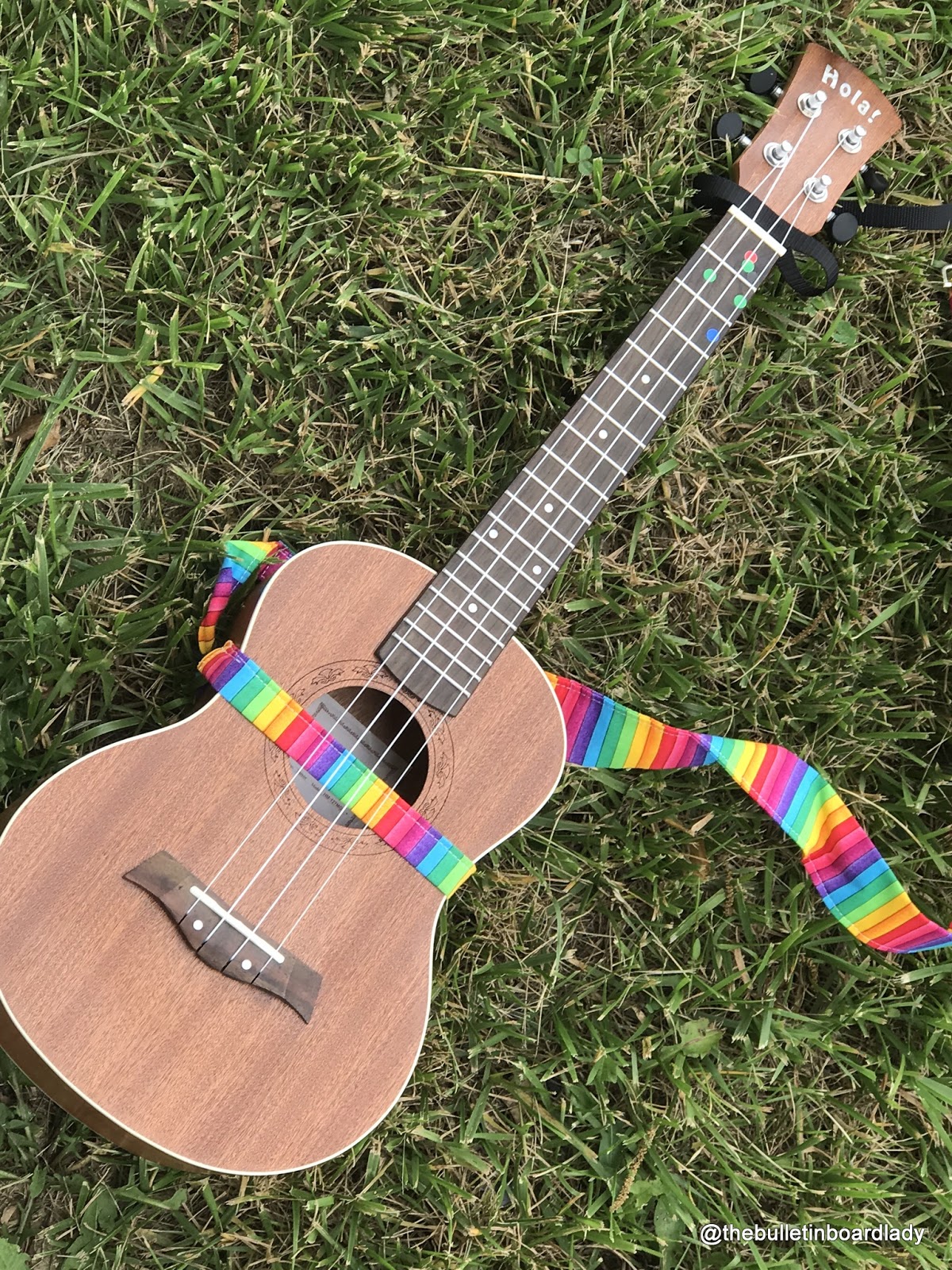
5. Ukuleles
I am relatively new to teaching ukuleles, but they have proven to be a versatile instrument and are perfect for taking outside.  Take a few song books for students to work on in small groups or move your whole group instruction out to the lawn.


Outside activities for music class can be just as engaging as activities that you plan for inside the music room.  Sing, dance, play and assess in the sunshine.  Nine practical ideas for beautiful days in music class.

6.  Four Corners - Instrument Families
Four Corners is a game that has been around for a long time.  I use it to reinforce instrument families.  Draw the four corner boxes and in each one add the name of an instrument family.  One student calls out the name of an instrument and the players move to stand in the family box that it belongs in.  Anyone who is not in the correct box is out.

This game was great with second and third graders, but my 4th, 5th and 6th graders were too good!  To make it a little more complicated I created instrument cards for the caller to use.  I included many instruments from around the world, pictures of those instruments and then their name and family to make the game more interesting.  If the game gets to the point where no one gets out for 3 turns, then the caller turns around giving the players a chance to stand in ANY box and then chooses a family.  Anyone not in that family is out.  Play continues until there is one winner and that person becomes the new caller.


Outside activities for music class can be just as engaging as activities that you plan for inside the music room.  Sing, dance, play and assess in the sunshine.  Nine practical ideas for beautiful days in music class.

7.  Singing Rocks
Singing rocks are great inside or outside.  There's just something fun about taking them outside.  I explain how to make these rocks in this blog post:  Singing Rocks

Basically the rocks are used for singing improvisation.  Put the rocks in a bag or box that isn't easy to see into.  Pull out a rock and start singing about what is on the rock.  The song doesn't have to rhyme.  The next person pulls out another rock and continues the ballad by singing about what is on their rock.  This is a great way to introduce the idea of opera too.  I've used this activity as a workstation and as a whole group activity.

8.  Singing Games/Folk Dancing
Ah!  Finally enough room to do all of those dances as an entire class instead of a couple of different groups taking turn!  A sunny, grassy area is the perfect place for folk dancing and singing games.


9.  Music Symbols Chalk Drawings
My daughter and I love going outside to create chalk art and so do my students.  I give them a sheet with music symbols on it and challenge them to create art using ONLY music symbols.
 Purchase this as part of the Jazzy Jack-o-Lanterns bulletin board.
I love the results!  While students are creating I engage them in conversations about the symbols they are using.  Win!  Here are a couple of examples:
Outside activities for music class can be just as engaging as activities that you plan for inside the music room.  Sing, dance, play and assess in the sunshine.  Nine practical ideas for beautiful days in music class.
A tree composed of a whole note trunk.

Outside activities for music class can be just as engaging as activities that you plan for inside the music room.  Sing, dance, play and assess in the sunshine.  Nine practical ideas for beautiful days in music class.
I think this was really just a beautiful picture.  Although it wasn't a picture of something made with music symbols, it was a beautiful picture made only of music symbols.  The next picture is an example of one of "those" kiddos that technically followed the rules, but was obviously pushing the boundaries.  It made me laugh so while he was going to get more chalk to clothe the musical man below I snapped a picture.  I must admit that it was pretty good AND used only music symbols, but you know.


I hope that these ideas have inspired you to take your music class outside to enjoy a beautiful day.  Do you already take your classes outside?  I'd love to hear your ideas in the comments below.

If you like these ideas, PIN them for later.

Outside activities for music class can be just as engaging as activities that you plan for inside the music room.  Sing, dance, play and assess in the sunshine.  Nine practical ideas for beautiful days in music class.


post signature

STEAM in the Music Room: Makey Makey

The Makey Makey is a great invention tool!  Help your students use it in the music room with these music class tested ideas.  STEAM learning can be fun!

I'm a gadget girl.  I have always been a gadget girl.  My heart leaped the first time I saw the Makey Makey in action and I knew I had to give it a try.  Makey Makey is an electronic invention too.  It allows you to connect everyday objects to computer programs.  It uses a small circuit board, alligator clips and a USB cord to connect to your computer and the objects you choose.  Essentially it is creating an electric circuit and sends closed loop electrical signals to the computer.  The computer responds in virtually any app because the Makey Makey uses mouse clicks and key strokes.

The Makey Makey is a great invention tool!  Help your students use it in the music room with these music class tested ideas.  STEAM learning can be fun!

So what, right?  Well did I mention that it can connect to simple percussion and piano apps?  This let's you essentially play the piano on bananas, Play-Dough or even hot dogs.  FUN!  The Makey Makey can allow your students create new "instruments" to play with every day objects.

The Makey Makey is a great invention tool!  Help your students use it in the music room with these music class tested ideas.  STEAM learning can be fun!

The Makey Makey comes with instructions that are ridiculously easy to follow so I won't go into a step by step.  Basically you plug the USB cord into the Makey Makey and your computer.  You connect yourself to earth (which is a section on the circuit board) and then you connect the circuit board to some other object.  You can choose any of the arrow keys, space bar or click.  When you touch the everyday object (like a banana) you complete the circuit and the computer receives the command.

The Makey Makey is a great invention tool!  Help your students use it in the music room with these music class tested ideas.  STEAM learning can be fun!

Actually, you can connect to much more than just those basic six.  If you turn the circuit board over there are more options.  I have played with this advanced option but I haven't used it with students yet.  One of my struggles with STEAM lessons is that my students don't always have the tech skills that they need to complete projects like this.  To ensure student success, I have to plan time to teach the technical skills they will need and THEN we can focus on the musical part. 

In a perfect world, students would already have experience with the Makey Makey and understand the basics of how it works.  They would have experimented with different objects to see what choices conduct electricity.  They don't come to my classroom with these experiences under their belt. At least, most of them don't so I take the time to teach them about the science and the technology portions of this lesson.

I have created a few mats for students to use.  They contain the same notes as the Makey Makey piano.  I place some simple song sheets with them and students can play songs on marshmallows, hot dogs, gummy worms, etc...

After students are able to use the Makey Makey, the next step is to set them free!  Inspire students to compose a simple melody based on the objects they have connected to the computer.  For example you might challenge students to compose a melody with the Makey Makey connected to spoons and then also create a percussive ostinato on more spoons to play with it.  My students always love creating punny titles for their composition.  I imagine this one might be "SPOONlight Sonata" or "The Spoon Tune".  

Here are a couple of my favorite ideas:
The Makey Makey is a great invention tool!  Help your students use it in the music room with these music class tested ideas.  STEAM learning can be fun!
This composition was based on a Play Dough keyboard.  They used different colors of dough and formed them into different shapes and then connected the Makey Makey.  They used stick notation to indicate how many times to play each pitch.  The title is "Dough a Deer, A Playdo Deer".

The Makey Makey is a great invention tool!  Help your students use it in the music room with these music class tested ideas.  STEAM learning can be fun!

Can you guess what this composition was played on?  Gummy bears!  I love that they included a key at the bottom of their composition.

The Makey Makey is a great invention tool!  Help your students use it in the music room with these music class tested ideas.  STEAM learning can be fun!

The set that I have for the Makey Makey in my TpT store has 3 task cards for getting the Makey Makey setup and trying it out, 3 different staff and keyboard displays (I laminate these and students set their objects on the note they will play.), 4 simple songs and a workstation sign.  You can download it HERE.

You can find more information about the Makey Makey on their website.  If you liked these ideas, PIN them for later:
The Makey Makey is a great invention tool!  Help your students use it in the music room with these music class tested ideas.  STEAM learning can be fun!


post signature

Workstations for Teaching Treble Clef Pitches

Learning the names of the treble clef lines and spaces is a basic music skill.  Using workstations to practice it only makes sense. See ideas for using centers in your music classroom  to teach pitch names of notes on the treble clef staff.

Workstations are one of my favorite things to facilitate in my classroom.  I tend to use workstations with a similar theme.  For example if I am teaching instruments of the orchestra, I will create 4-6 workstations that review that topic.  In this blog post I'm sharing some ideas for using workstations to review treble clef pitch names and practice using this skill.

Learning the names of the treble clef lines and spaces is a basic music skill.  Using workstations to practice it only makes sense. See ideas for using centers in your music classroom  to teach pitch names of notes on the treble clef staff.

Worksheets
I know it sounds boring, but completing a note naming worksheet only takes a few minutes and provides me with a written assessment of their understanding.  I always include worksheets in my rotation.  You probably have a plethora of worksheets that would work perfectly.  I have a growing bundle of worksheets that you might like for purpose.  Download them HERE.  

Learning the names of the treble clef lines and spaces is a basic music skill.  Using workstations to practice it only makes sense. See ideas for using centers in your music classroom  to teach pitch names of notes on the treble clef staff.

Flashcards
Yes, old timey flashcards are a GREAT workstation to include in your rotation.  Students can quiz each other or just quiz themselves.  You could create a PowerPoint or Google slides show that could be used as digital flashcards too.  In the picture above, my students are playing Treble Clef Uno by Amy Abbott.  They aren't really flashcards, but do reinforce the pitch names while they play.  

Learning the names of the treble clef lines and spaces is a basic music skill.  Using workstations to practice it only makes sense. See ideas for using centers in your music classroom  to teach pitch names of notes on the treble clef staff.

Keyboard Work
I found this beauty at a local yard sale and snatched it right up.  It is so fun to "dance" and play music.  This big piano is great for several workstations, but in this rotation I just sat out a Recorder Karate book and a beginning piano book with a few pages marked.  I've also used some simple folk songs as well.  Students read the notation and played by stepping on the notes.  Some clever students sat on the floor and used their hands too.

Pitch Match Ups
I have a ton of these so I can have students work in small groups and see who can finish (correctly!) first or I use them as a workstation.  I store them in plastic photo boxes.   Sometimes I'll just show the notes and see if students can come up with the word it "spells" while we are waiting in line.  I've also used them like a memory game where the cards are laid face down and students have to match them.  Fun!  You can see all of them here:  Pitch Match Ups

Learning the names of the treble clef lines and spaces is a basic music skill.  Using workstations to practice it only makes sense. See ideas for using centers in your music classroom  to teach pitch names of notes on the treble clef staff.
Music Apps
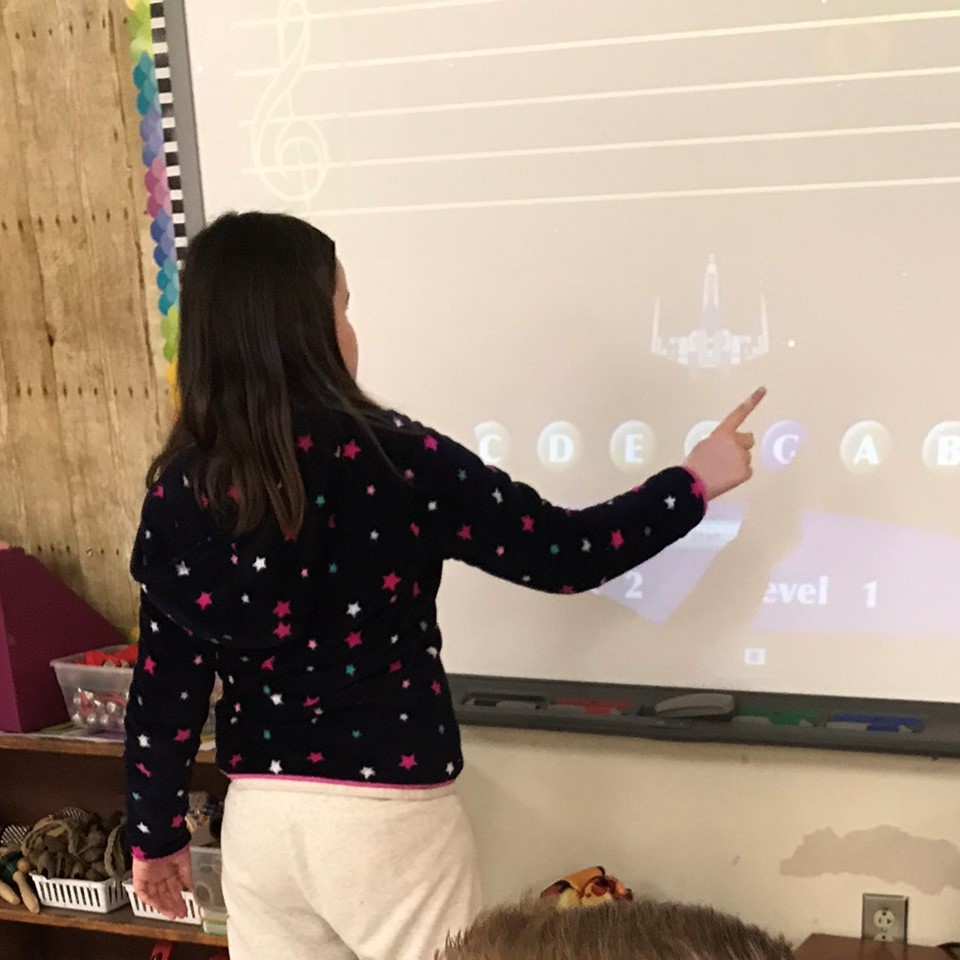
My students are huge fans of Staff Wars.  This game is free for your computer and is fun to play projected onto your interactive whiteboard.  If you have iPads, the app is $ .99 and worth every single penny!  Other pitch name apps that you may like:
Note Names Lines and Spaces (This game is on Kahoot.  Your students can play this game against each other.  Project it onto the Smartboard and students login with their devices to play. FUN!)


Computer Games

Note Names (by Classics for Kids)


Learning the names of the treble clef lines and spaces is a basic music skill.  Using workstations to practice it only makes sense. See ideas for using centers in your music classroom  to teach pitch names of notes on the treble clef staff.
Boomwhackers
My students love playing Boomwhackers and I love that they can use them to work together.  I use a set of color coded folk songs from Musical Magic for Boomwhackers.  I've printed them and laminated them (you could also use page protectors) and just set them on a stand near my Boomwhackers.  FUN!

I've also used desk bells (also colored like Boomwhackers) for this station.  If I have a large group I usually add another center with some of those folk songs and a set of bells.  The bells are much louder than the Boomwhackers so I have to find a place for them to work that won't disturb the whole room.  Usually a corner or facing my desk works well.

Learning the names of the treble clef lines and spaces is a basic music skill.  Using workstations to practice it only makes sense. See ideas for using centers in your music classroom  to teach pitch names of notes on the treble clef staff.
Dabbers
I use dabbers for any centers rotation I can because my students are 100% engaged when they use them.  I have 2-3 worksheets available at this station for students to complete.  You can read THIS blog post to learn about how I use dabbers in my classroom.  You can take a closer look at the dabber worksheets that I've pictured above HERE.

Learning the names of the treble clef lines and spaces is a basic music skill.  Using workstations to practice it only makes sense. See ideas for using centers in your music classroom  to teach pitch names of notes on the treble clef staff.
Bottle Caps
If you are a long-time reader of this blog, you know that I love recycling bottle caps to use in my classroom.  I use them as note heads on staves I've printed on paper.  It's fun to say a word and have students move their bottle caps on the staff to spell that word using the lines and spaces of the treble clef staff.  I have a set that you can download in my store that contains the words (as answer keys) and a blank staff for this activity.  See it HERE.

You can also use the bottle caps as part of sorting activities.  Read THIS blog post to learn about how to create a sorting workstation with bottle caps and dip and chip trays.  It's a great workstation and you can download the notes shown on the bottle caps above in that blog post.

Learning the names of the treble clef lines and spaces is a basic music skill.  Using workstations to practice it only makes sense. See ideas for using centers in your music classroom  to teach pitch names of notes on the treble clef staff.
Treble Clef Twister
This is an oldie but a goodie!  Treble Clef Twister is pretty easy to play.  I've used tape to create a staff on my carpeted floors.  Now I use a shower curtain.  I created the staff using electrical tape.  Students use THIS spinner to hear "Left hand G!" or "Right food E!"  


Sometimes I'll create a station for assessment.  I'll sit there with students and either quiz them with flashcards or have them complete an exit ticket.  This gives me an idea of how much more I need to teach on this topic before we move to something else.  In reality I am always reviewing pitch names and rhythms in 3rd through 5th grades, but a day of treble clef pitch workstations is always well spent.

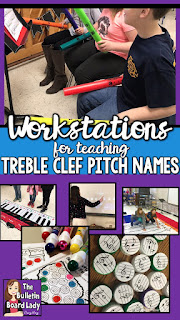
If you like these ideas for treble clef pitch name workstations, PIN this post for later.

Learning the names of the treble clef lines and spaces is a basic music skill.  Using workstations to practice it only makes sense. See ideas for using centers in your music classroom  to teach pitch names of notes on the treble clef staff.

post signature

Assessment in Music Class -What Do You Hear?

Looking for practical ideas for assessing hundreds of music students in your classroom?  Check out this idea for assessing rhythm skills called "What Do You Hear".

Can I confess something to you?  I have no idea how any of my elementary or junior high teachers came up with a grade for me.  Not a single one.  Did they just "give" me a grade?  Did I do something to earn it?  Was there every any real assessment?  I don't think so.  I think that I got an A because I was a good kid that did what I was told.  Of course, that must mean that kids that didn't do that would have received a different grade.  Is that crazy?  Have you been guilty of that?

I guess that is one of the reasons that assessment has been so important to me.  I've created hundreds of rubrics, sat through dozens of assessment workshops for math and reading teachers trying to glean everything I could and challenged other music teachers to show me how they plan for authentic assessment.  I've learned that there is a wide variety of strategies for grading or assessing students in music class.  I've seen elaborate data tables and heard others say "I just give them an S, no matter what."  Whaaaat?  I've tried to find a balance based on how often I see my students and what I want them to be able to do when they leave my classroom.

Today I'm going to share with you one of my favorite tools for assessing rhythm skills.  I call it ear training, but it isn't exactly what I remember doing for my Ear Training classes in college.  I use these assessments most often with 3rd through 6th grades but they could be adapted for use with younger and older students.  When I taught high school band I used this type of assessment all of the time.

Check out this video to see how I use my What Do You Hear set of worksheets.  You can download them HERE if you are interested in trying them out in your classroom.


Like this idea?  PIN IT for later!
Looking for practical ideas for assessing hundreds of music students in your classroom?  Check out this idea for assessing rhythm skills called "What Do You Hear".


post signature