Header

Mrs. King at Home About Mrs. King Contact Mrs. King Mrs. King's Music Class HOME Image Map
Showing posts with label Composers. Show all posts

Composer of the Month -John Williams

John Williams is the composer of the month!  I love sharing the music of John Williams with my students as much as they love learning about it.  A big Star Wars fan, my students are always impressed with how much I know about the Star Wars world.  Don’t worry.  Although I know a Wookie from a Bantha, I am light years away from being an expert.  I do however, know a thing or two about the composer of the music for these movies.  I hope you’ll enjoy learning about a few resources and activities that I use when studying the music of John Williams.


When we do this activity, I’ll call my steady beat swords “steady beat light sabers”.  I’m the coolest teacher in school for about ten minutes!  For this activity we practice keeping the beat with a partner and then use our steady beat swords (a.k.a. pool noodles with duct tape make to look like swords).  I use “Imperial March” by John Williams.
I’ve blogged about this activity before.  You can read it HERE.

These glyphs were designed specifically for the music of John Williams.  I use them with 1st and 2nd grades (guiding them through the listening activity) and with 3rd through 6th grades.  My older kids often miss the opportunity to color so they enjoy being able to complete a listening journal in this manner.  Check out some of their great work!


Well, of course there’s a bulletin board!  I use this John Williams Composer of the Month set to display in my classroom. Actually, this time it was in the main hallway.  Around Christmas I found some great Star Wars wrapping paper that wasn’t too Christmasy and I used it to add some interest to the bulletin board.  The rest of the board was just print and post.  One of my classes completed the writing prompt that comes in this set with a substitute.


Now what are you waiting for?  It's time to celebrate the music of John Williams!
post signature

Expanding Your Child's Listening Repertoire


I’m often asked if I listen to a variety of music when I’m not teaching.  I'm pretty sure some people think I only listen to children's music 24 hours a day.  *giggle*  Not so much.  The answer?  Absolutely!  I can honestly say that I like a little bit of everything.  I try to reflect this in my teaching and choose songs from a variety of genres.  Some kids aren’t sure what they like or don’t like so I want to give them a smorgasbord of choices.

My daughter is three and loves to sing and dance and listen to music.  Unfortunately for me, she wants to hear the same song over and over.  It’s not her fault.  It’s how her brain works and helps her learn.  My son did the same thing when he was younger.  If you are trying to teach your child to enjoy more than one style of music or maybe even just more than one song, make it a game!

Freeze Dance
To play Freeze Dance choose a few songs of different genres and tempos.  Play the song and dance, dance, dance with your child.  Occasionally press pause and freeze just like you were.  The poses are so silly and fun that your child will want to play all the time!  Here are some suggestions for songs to use in different genres.

 Classical
“Eine Kleine Nachtsmusik” by Mozart
“Rodeo” by Aaron Copland
“Finale to William Tell’s Overture” by Rossini
“Syncopated Clock” by Leroy Anderson

Country
“Grandma’s Feather Bed” by John Denver
“Rocky Top” by the Osbourne Brothers
“Don’t Rock the Jukebox” by Alan Jackson
“BINGO” by Merle Haggard (found on Country for Kids by Disney)

Jazz/Blues
“Salt Peanuts” by Dizzy Gillespie
“Old MacDonald” by Ella Fitzgerald
“Potato Chips” Slim Gaillard
”What a Wonderful World” Louis Armstrong

Rock/Pop
“Walking on Sunshine”  by Katrina and the Wave
“Best Years of Our Lives” by Baha Men
“Let’s Get it Started” by the Black Eyed Peas
“Boom! Shake the Room” DJ Jazzy Jeff and the Fresh Prince

Do you have other favorites that you use with your students or children?  Let me know in the comments.  I'm always looking for new additions to my collection.
 
 
post signature

Nutcracker Nuttiness: Resources for Teaching the Nutcracker Ballet


It’s here!  It’s here!  It’s time to study the Nutcracker in music class!  My kiddos seem to think I’m just a little nutty about this classic ballet.  Some years in music class every class watches the complete Nutcracker.  Other years some classes watch portions and do other activities.  It seems that I’ve collected quite a few activities over the years and found several new ones I hope to incorporate this year.
Last year I created a bulletin board that focused on some vocabulary from the ballet.  This board is seasonal and uses beautiful clipart to present the information.  I like to leave this up as a resource during December.  Get it here.
http://www.teacherspayteachers.com/Product/Nutcracker-Vocabulary-Bulletin-Board-Kit-1003503
 
This year students are working with listening glyphs.  I’ve created a set of Nutcracker Listening Glyphs that highlight some of the pieces the students hear while watching the ballet.  With Kindergarten and First Graders, we actively listen to a piece.  Active listening means we point at a listening map, move to the music, raise our hands when we hear parts that are the same or different and so on.  Then I pass out the glyphs and we go through them step by step.  With older students they are able to listen and answer a few questions about the piece and then complete the glyphs on their own.  Get it here.
http://www.teacherspayteachers.com/Product/Nutcracker-Listening-Glyphs-1562925 http://www.teacherspayteachers.com/Product/Nutcracker-Listening-Glyphs-1562925 http://www.teacherspayteachers.com/Product/Nutcracker-Listening-Glyphs-1562925
 
 
Here are a few other resources from friends of mine that you’ll want to grab:
http://www.teacherspayteachers.com/Product/Nutcracker-Notetaking-1018736
 
Nutcracker Note Taking by Sally Utley from Sally’s Sea of Songs
In this kit, Sally sets students up for success by providing a framework for taking notes while watching or listening to the Nutcracker.   My upper elementary students can always use practice in note taking and this would be a great way to do it. 
http://www.teacherspayteachers.com/Product/Nutcracker-Ballet-Scavenger-Hunt-1581970
 
Nutcracker Scavenger Hunt by Ginny Capps from Ginny’s MusicSpace
Oh my goodness!  This is such a great idea.  Although I love to review with my students, they really get restless just sitting down and going through worksheets and notes.  Ginny has created a clever way to review the Nutcracker AND get moving.  In this scavenger hunt students are given a sheet to record their answers that contains clues.  All around the room you place the colorful card with pictures of things like a ballerina, Tchaikovsky, pointe shoes, etc…  Students take their clues and search the room for their answers.
 
http://www.teacherspayteachers.com/Product/Rhythm-Basketball-Nutcracker-4th5th-Grade-Lesson-Plan-Rhythm-Practice-Guide-1582654
 
Rhythm Basketball: Nutcracker Edition by Shelley Tomich from Pitch Publications
FUN!  In this fun activity students “play along” to music from the Nutcracker with basketballs!  I can’t wait to try this out with my 4th, 5th and 6th graders.  Shelley has instructions for use, written lesson plans and PowerPoints to guide students through playing simple rhythm patterns to March, Trepak and the overture.
http://www.teacherspayteachers.com/Product/Visuals-and-Activities-for-the-Nutcracker-987088
 
Visuals and Activities for the Nutcracker by Aileen Miracle
Wow.  This is such a comprehensive collection of activities for studying the Nutcracker!  Aileen actually has 2 sets of visuals and activities.  See the first one here and the additional one here.  In these sets you’ll find instructional presentations, rhythm activities including play-alongs, an ostinato activity, and more.  There are coloring sheets, activities for form, bulletin board visuals and lots more.  I love that there are so many options to choose from in these collections.  I could easily use these with my K-6 students.  As a teacher that has taught K-6, PK-8 and K-12 I really appreciate the thoughtful way that these activities were designed.
 
http://www.teacherspayteachers.com/Product/The-Nutcracker-Rhythm-Play-Along-Mini-Bundle-1565331
 
Nutcracker Mini-bundle of Play-Alongs and More by TonyaLeJuene
In this delightful set you’ll find play-alongs, activities for teaching form and some vocal explorations.  I just can’t wait to use her movement activities for “March” from the Nutcracker.  The kids love moving and the fact that they’ll be exploring form at the same time thrills me.  They'll be stomping and patting and learning.  Love!  This is definitely a set to add to your Nutcracker repertoire.
 
http://www.teacherspayteachers.com/Product/Nutcracker-Story-Review-Koosh-Ball-Game-with-a-surprise-1564610
 
The Nutcracker Story Review Koosh Ball Game by Karla Cherwinkski of C Major Learning
This is such a clever activity!  I don’t know about you, but my kids love games where they get to be physically active.  They are going to LOVE tossing a koosh ball at the SmartBoard!  This game is a review of the story of The Nutcracker by Vladimir Vagin.  To play the game you open the interactive PDF (which is a seriously cool way to set this up) and find a collage of Nutcracker clipart.  Toss a koosh ball and depending on where it touches, a questions opens.  Fun!  I must admit that I have loved these little toys ever since the Rosie O’Donnell Show.  J
http://www.teacherspayteachers.com/Product/I-Spy-The-Nutcracker-Hidden-Music-Symbols-1432363
 
I Spy the Nutcracker by Jennifer Foxx of Foxx Piano StudioResources
My kiddos love to play games and I love to be sneaky and use games to reinforce what we are learning about.  This I Spy game can be played as one whole group, with individual students or in teams.  Using the Nutcracker theme students draw a card and are asked to find that symbol on the page that is displayed.   I think that the way she has set this up would make it easy to use in centers too.  I think I may add it to my December workstations after we’ve used this as a whole group. 
 
http://www.teacherspayteachers.com/Product/COMPOSER-ACTIVITIES-Peter-Ilyich-Tchaikovsky-1526275
Composer Activities-Tchaikovsky by Joyce Moore of JoyfulMusic
This product is a goldmine of cross curricular awesomeness.  This curriculum integration tool incorporates history, math and writing activities into your music lessons.  There’s an Orff arrangement included as well as for instruments and voices.  The lyrics are pretty catchy, so prepare to go around singing it for the rest of the day!  I love how accessible all of the activities are and that there are practical ideas for using them in your classroom.
 
http://www.teacherspayteachers.com/Product/The-Nutcracker-MEGA-Bundle-of-Listening-Activities-1588354
The Nutcracker MEGA Bundle by Katie Robertson of Cowgirl Compositions
Oh.my.goodness.  There are so many amazing things in this bundle that I am just not sure where to start.  This set includes 8 pieces from the Nutcracker with worksheets, animated listening maps, play alongs, assessments (that are quick and easy to do!), history and social studies connections, fun facts, a composer bio and...I'm probably forgetting some of the awesomeness.  I love the rhythm composition sheets that are included.  I also love how practical and useable each activity is during this crazy busy time of the year.
 
I hope you've enjoyed perusing some of my favorite activities or teaching the Nutcracker.  Feel free to comment below with some of your favorites! 
 
post signature

Coloring Composers

For many years I've pulled all of my tools out of my teacher's bag of tricks to find ways to get students to listen for more than 3 minutes to the music of some of the world's greatest composers.  I've done active listening with activities like keeping the steady beat, moving to show form, listening for instruments, raising their hands when they hear a certain element and so on.  What I wanted was to create an experience where students had a more extended time to listen (say 10 minutes or so) so that they could hear several pieces by the same composer.  This is difficult. 

After about 2 minutes they are wiggly.  After 3 minutes they are looking around the room and are disengaging.  Soon they are talking and our listening time has turned into me telling kids to be quiet.

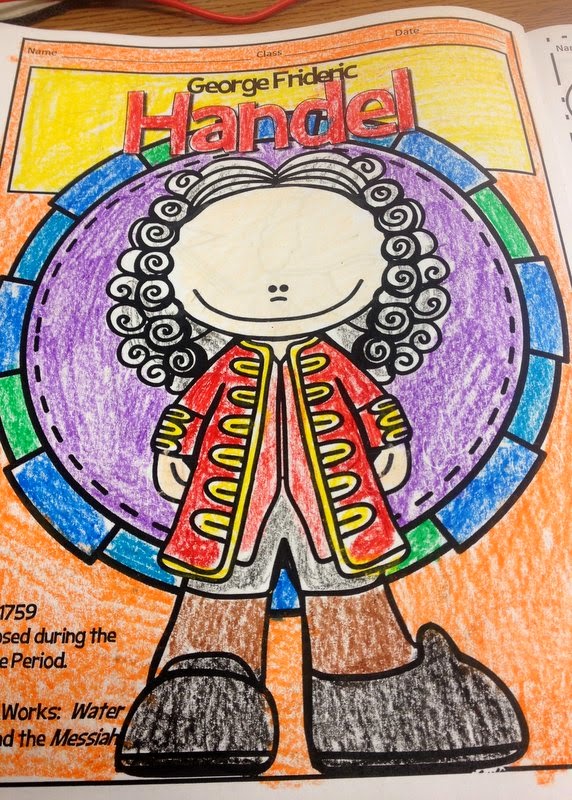
Until now!  As the school year comes to a close I've created composer coloring sheets for students to color while listening to that composer.  Since my 2nd graders study composers all year, they were the group that I experimented with.  They loved coloring the composers and reading a little bit about them.  They also loved listening to several pieces while they colored and often commented about where they had heard it before, what it reminded them of and more.  Higher levels of thinking and active educational conversations from a color sheet? YES!

Here are some more examples (some in progress) of our listening times.


You can get these HERE.  It includes these composers:
Johann Sebastian Bach
Ludwig van Beethoven
Johannes Brahms
Benjamin Britten
Frederic Chopin
Aaron Copland
George Frideric Handel
Franz Liszt
Wolfgang Amadeus Mozart
Franz Schubert
Peter Illyich Tchaikovsky
Richard Wagner

I also have a second set that includes
Leonard Bernstein
Claude Debussy
Antonin Dvorak
Edward Elgar
Joseph Haydn
Leroy Anderson
Sergei Prokofiev
Gioachino Rossini
Camille Saint-Saens
Scott Joplin
Johann Strauss
Clara Schumann

Steady Beat Swords

It's been such a great week in Kindergarten and First Grade Music!  We've been experiencing steady beat with steady beat swords.  The "swords" are actually swimming noodles that have been cut in half.

First we listened to "Imperial March" from Star Wars and found patterns in the music that sounded like we should march, swing our steady beat swords and sneak around.  Then we kept the steady beat by clapping one hand with our partner.  Next we took that skill and transferred it to our steady beat swords.  We clicked our steady beat swords together on the beat with our partner.

As we listened to the song the next time we marched, light saber-ed to the beat and snuck around the galaxy in search of a new beat keeping partner.  What fun!

Read another blog post about steady beat swords HERE.


Listening to Beethoven

I almost forgot that I had scanned these to share with you!  A few weeks ago we listened to "Moonlight Sonata" by Beethoven.  First graders discussed tempo, mood and dynamics and then created these written/drawn responses.


They had some pretty heavy thoughts about the song.  It was a great opportunity to talk about how music captures emotions.  We discussed music that is used for weddings, funerals, parades, parties, etc...  What insightful young men and women I teach!

UPDATED:  Just to answer a few questions that I've recieved in the comments or via email for teachers wishing to teach this lesson:  To introduce the piece I talked about Beethoven and explained that sometimes (not always!) but sometimes composers like to tell stories with their music the way authors do with books.  I asked them to listen to the piece and then asked them to label it generically by asking them what the tempo was, what instrument did they hear, what was the "mood" of the piece.  Then I asked them to imagine they were creating a movie.  What would be showing on the movie when they heard this music.  We shared two or three examples and then went to the sheets to express our ideas.  Too many examples and students don't think about their own response, but on which response they heard that sounded the best!

This sheet is part of a Primary Writing Prompt Kit that you can find HERE.

Candy Cane Ponies and Musical Form

This week students in the younger grades listened to a "March" from the Nutcracker ballet.  After deciphering the form we discovered that there was a repeating A section.  That means "March" is in rondo form.  Then we added maracas and jingles to indicate galloping and marching sounds in the music.  It wasn't enough to just play the different parts, so we pulled out our Candy Cane Ponies and marched and galloped to show the form of the song!  During the B and C sections we took short breaks to feed our ponies carrots from our pockets and to give them drinks of water.  What a hoot!


You can download the recording we used from Tchaikovsky's ballet here.  Teachers:  This activity is from Parachutes and Ribbons and Scarves, Oh My! by the talented Artie Almeida.